Project management for digital marketing is the structured process of planning, coordinating, executing and measuring digital marketing campaigns and marketing content production across teams and channels.
It covers the full lifecycle of a marketing project, including briefing, task assignment, creative production, review and approval, content distribution and performance measurement across channels such as search, social media, email, display advertising and web. As marketing teams produce more content across more platforms, structured project management helps reduce delays, improve visibility and keep campaigns moving efficiently from planning through launch.
For modern marketing teams, campaign complexity has grown significantly as brands operate across more channels, produce more marketing content and involve more stakeholders in every production cycle. Without structured project management for digital marketing, projects stall, marketing content gets lost, approvals become bottlenecks and teams lose visibility of what is happening across concurrent campaigns.
This guide covers what digital marketing project management involves, the methodologies teams use, the stages of a typical marketing project, prioritization frameworks or best practices, common challenges and how the right tools, including digital asset management (DAM) platforms with integrated workflows, support the process from start to finish.
At-a-Glance: Marketing Project Management
| Definition | The structured process of planning, executing, tracking and optimizing marketing campaigns and content production across teams and channels |
| Common Methodologies | Agile, Kanban, Waterfall, hybrid |
| Key Stakeholders | Marketing Leaders, Creative teams, Marketing Compliance Reviewers, Brand teams, agencies, channel and distribution partners |
| Typical Tool Categories | General-purpose project management software, marketing-specific project management software, DAM platforms with integrated workflows |
| Primary Goal | Deliver marketing campaigns and content on time, on budget and on brief, with consistent quality and brand integrity |
| Common Challenges | Scope creep, approval bottlenecks, marketing content version control, cross-team visibility, brand consistency, compliance requirements |
| Prioritization Frameworks | Eisenhower Matrix, MoSCoW, RICE scoring, weighted scoring |
| Success Metrics | On-time delivery rate, approval cycle time, asset reuse rate, rework volume, campaign time-to-market |
Why Digital Marketing Teams Need Project Management
Digital marketing teams need project management because the complexity, volume and pace of modern campaign production exceed what informal coordination and generic task management can reliably handle.
Several converging pressures are driving adoption:
- Multi-channel campaign complexity:
A single campaign today may require marketing content across email, paid social, display advertising, organic social media, web landing pages, video, audio and out-of-home, each with different specifications, timelines and distribution requirements. Coordinating this across multiple teams without a structured process creates delays and inconsistencies. - Accelerating content volume:
Marketing teams are producing more marketing content per campaign than ever before. Managing the volume of individual files, variants and versions across concurrent projects requires systems, not spreadsheets. - Cross-functional team coordination:
Most marketing projects involve Creative teams, Marketing Compliance Reviewers, Brand Leaders, legal stakeholders, external agencies and channel partners. Each group operates with different tools and priorities. Without shared project visibility, coordination breaks down at handoff points. - Speed-to-market pressure:
Market windows are shorter and competitors move faster. Delays in review and approval cycles directly affect time-to-market and campaign performance. - Marketing compliance and brand consistency requirements:
In regulated industries, marketing content must meet legal and regulatory standards before distribution. Even outside regulated sectors, maintaining brand consistency across a distributed team producing high volumes of content requires structured review and approval processes. Purpose-built marketing compliance software addresses this in a way that general project management tools cannot.
Key Components of Marketing Project Management
Marketing project management encompasses several interconnected process components that together cover the full content lifecycle, from initial briefing through to performance reporting.
Marketing Briefs and Campaign Planning
Every well-managed marketing project begins with a clear brief. A master brief establishes the overarching strategy, budget, target audience, key messages, creative requirements and timelines. Campaign and task briefs inherit approved strategy from the master brief and define the specific deliverables, channels and specifications for each workstream.
Structured marketing brief and request forms ensure that Creative teams receive consistent, complete information at the start of production, reducing the back-and-forth that delays projects before creative work has even begun.
Workflow Design and Task Management
Once a brief is approved, the project is decomposed into individual tasks with clear owners, dependencies and due dates. Workflow design defines the sequence of work, including which tasks must be completed before others can begin and where reviews or approvals create dependencies in the production timeline.
Visual project views, including Kanban boards and campaign calendars, give Marketing Leaders and Creative teams a shared view of project status, workload distribution and upcoming milestones without requiring constant status meetings.
Creative Content Management and Version Control
Marketing projects generate a large volume of individual files, including source files, approved versions, resized variants, archived drafts and reference materials. Managing this content requires a centralized system that maintains version history, prevents duplication and makes the current approved version of every file clearly identifiable.
Without centralized content management, teams waste significant time searching for the right version of a file, recreating marketing content that already exists and distributing outdated or unapproved versions. This is one of the core problems that DAM platforms are designed to solve.
Review, Approval and Marketing Compliance
The review and approval stage is consistently the most variable and risk-prone part of the marketing project lifecycle. When approval processes are managed through email, stakeholders lose track of what needs their attention, feedback is fragmented across different threads and there is no auditable record of who approved what and when.
Structured creative approval software replaces ad hoc review processes with automated routing, inline feedback and recorded sign-off, reducing cycle time and improving marketing compliance accuracy.
Content Distribution and Delivery
Approved marketing content needs to reach the right audiences, internal teams, agencies, sales representatives, partners and external channels, in a controlled and traceable way. Distribution from a single source of truth, rather than from email attachments or unmanaged shared drives, prevents outdated marketing content from reaching market and reduces the risk of brand consistency failures.
Reporting and Campaign Measurement
Closing the loop on a marketing project requires comparing actual delivery against planned timelines and budgets and measuring campaign performance against defined objectives. Review cycles at project close, including retrospectives on what caused delays or rework, generate the institutional knowledge that makes marketing project management improve over time.
Common Marketing Project Management Methodologies
Marketing teams apply several distinct project management methodologies depending on the type of work, team size and pace of production. Each has different strengths and fits different scenarios.
Agile Marketing Project Management
Agile marketing project management applies iterative, sprint-based planning to marketing work. Rather than defining every deliverable upfront and executing in a single linear sequence, Agile teams work in short cycles (sprints), typically 1 to 4 weeks, reviewing and adapting priorities at the end of each cycle based on performance data and changing business needs.
Agile works well for teams managing ongoing content production, where priorities shift frequently and the ability to adapt quickly matters more than adherence to a fixed plan. It is less suited to projects with fixed, sequential deliverables and hard external deadlines, such as a product launch tied to a specific date.
Kanban for Marketing Teams
Kanban is a visual workflow management method that organizes work into columns representing stages of production, typically something like “Briefed,” “In Production,” “In Review,” “Approved” and “Distributed.” Work items move through the columns as they progress, giving the team continuous visibility of what is at each stage.
Unlike Agile’s sprint structure, Kanban is continuous rather than time-boxed, making it well-suited to teams managing a steady flow of varied marketing content requests where work items have different sizes and timelines. It is particularly effective for visualizing bottlenecks in review and approval stages.
Waterfall Methodology in Marketing
Waterfall project management follows a linear, sequential process where each phase must be completed before the next begins. In a marketing context, this typically means completing strategy and briefing before creative production starts, completing production before review begins and completing review before distribution.
Waterfall is most appropriate for large, complex campaigns with fixed deliverables and external deadlines that cannot move, such as a major product launch or a regulatory-driven communications update. Its limitation is inflexibility: if requirements change partway through, revisiting earlier stages is costly and disruptive.
Hybrid Approaches for Marketing Projects
Most marketing teams in practice use a hybrid approach, applying different methodologies to different types of work. Agile or Kanban methods suit ongoing content production and social media management, where speed and adaptability matter. Waterfall-style sequencing suits major campaign launches, where dependencies are clear and stakeholder sign-off at each stage is essential.
The right blend depends on the team’s size, the mix of project types in its portfolio and the degree of external constraint imposed by launch dates, regulatory timelines or campaign calendars.
| Methodology | Structure | Flexibility | Best For | Planning Approach |
|---|---|---|---|---|
| Agile | Iterative, sprint-based | High | Ongoing content production; fast-changing priorities | Sprint planning with backlog refinement each cycle |
| Kanban | Continuous flow | High | Mixed content requests; visualizing bottlenecks | Pull-based; work pulled when capacity allows |
| Waterfall | Linear, sequential | Low | Fixed-scope campaigns with hard deadlines | Defined upfront with phase gates |
| Hybrid | Mixed | Medium to high | Marketing teams balancing campaign launches with ongoing content production | Agile for ongoing work; Waterfall for major launches |
How to Prioritize Marketing Tasks
Methodologies define how your team runs its work. Prioritization frameworks decide what gets done first. Without a structured approach, priorities tend to follow whoever is loudest in the room. Four frameworks work well for marketing teams.
Eisenhower Matrix
The Eisenhower Matrix sorts tasks by urgency and importance into four quadrants:
- Urgent and important (do now): a launch-day asset missing a required legal disclaimer
- Important but not urgent (schedule): building a new campaign brief template
- Urgent but not important (delegate): resizing approved content for a new channel
- Neither (drop): cosmetic revisions requested after a campaign has launched
It’s fast and intuitive for triaging individual tasks during busy periods, but it doesn’t account for resource cost or business impact.
MoSCoW Method
MoSCoW sorts campaign deliverables into Must have, Should have, Could have and Won’t have (this time). For example:
- Must have: the ad creative and landing page
- Should have: a social toolkit for the sales team
- Could have: an animated hero banner
- Won’t have: a full video production
Agreeing on these categories at the scoping stage makes priorities explicit and is one of the most effective defenses against scope creep.
RICE Scoring
RICE scores initiatives on Reach (how many people it affects), Impact (expected effect on a key metric, scored 0.25–3), Confidence (how sure you are of the estimates, as a percentage) and Effort (person-months required). The score is (Reach × Impact × Confidence) ÷ Effort. RICE takes longer to set up but gives Marketing Leaders a defensible, data-driven way to compare competing campaigns across a roadmap.
Weighted Scoring
Weighted scoring lets teams set their own criteria and weights. A typical model might weight strategic alignment (30%), revenue potential (25%), resource cost (20%), time sensitivity (15%) and brand impact (10%). Each project is scored against each criterion and the weighted scores are added up. It’s more flexible than RICE, but it needs upfront agreement on the criteria and weights.
Marketing Project Prioritization Frameworks Compared
| Framework | Complexity to Implement | Best For | Strengths | Limitations |
|---|---|---|---|---|
| Eisenhower Matrix | Low | Individual task triage; high-volume periods | Fast, intuitive, requires no data | Does not account for resource cost or business impact; too simple for multi-project prioritization |
| MoSCoW | Low to Medium | Project scoping; aligning stakeholders on requirements | Explicit, collaborative, reduces scope creep | Subjective categorization; requires stakeholder agreement upfront |
| RICE Scoring | Medium to High | Roadmap prioritization; comparing competing initiatives | Data-driven, defensible, comparable across projects | Time-intensive to set up; estimates can be imprecise |
| Weighted Scoring | Medium | Teams with defined strategic priorities; leadership reporting | Flexible, customizable, reflects organizational values | Requires upfront alignment on criteria and weights; can be gamed |
Stages of a Digital Marketing Project
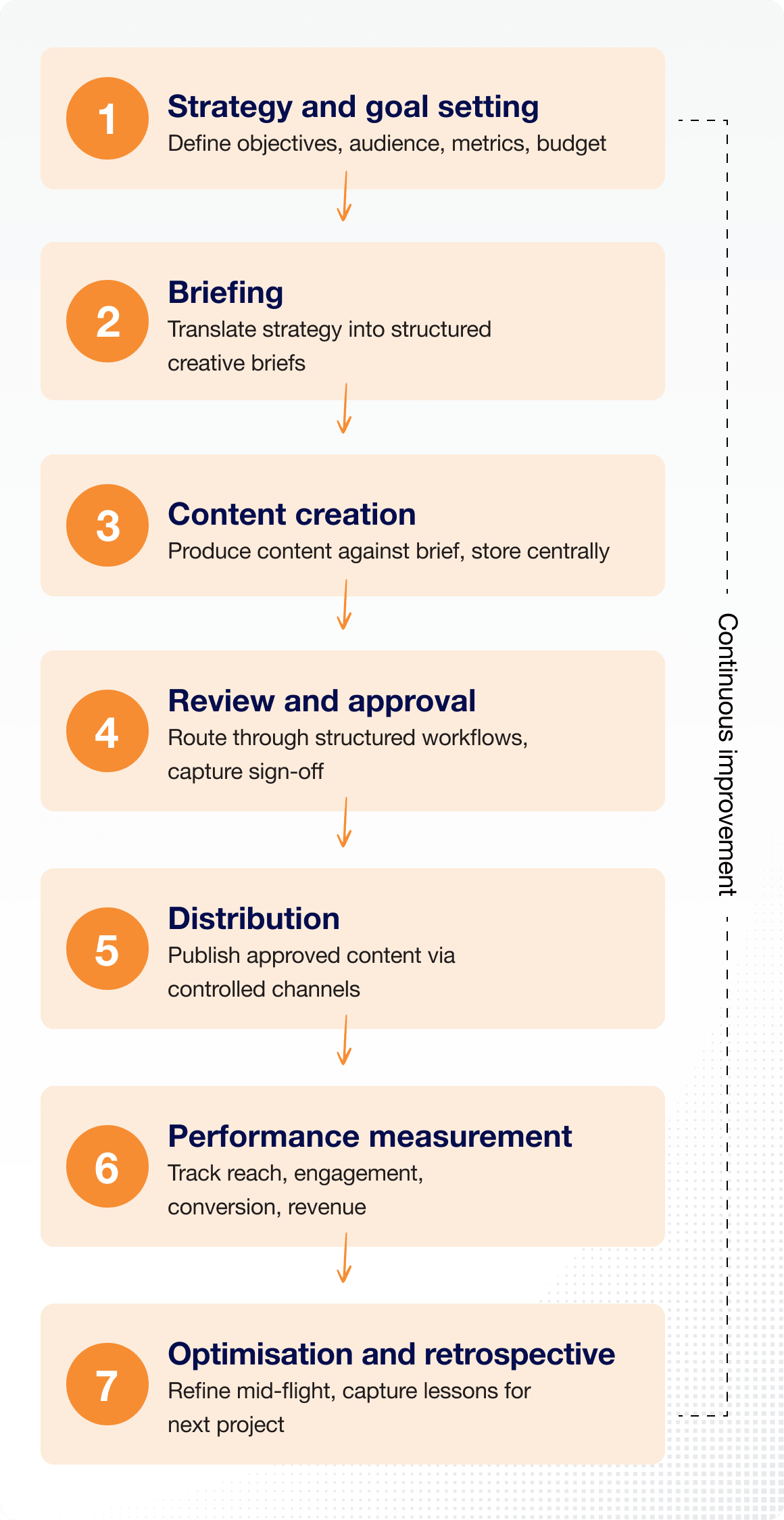
A well-managed digital marketing project moves through eight stages, each with defined inputs, outputs and handoffs to the next stage.
- Strategy and goal setting.
Define the campaign objectives, target audience, key messages, success metrics and budget. This is the stage at which the project’s scope is established and stakeholder alignment is secured. Decisions made at this stage shape timelines, production complexity and review requirements across the project. Using a framework such as MoSCoW at this stage makes priorities explicit and prevents scope creep later. - Briefing.
Translate the approved strategy into structured campaign and task briefs that provide Creative teams with the information they need to begin production. A complete brief includes audience definitions, channel specifications, content requirements, mandatories, timelines and approval requirements. - Task breakdown and ownership.
Break the project into production, review and distribution tasks with clear owners, dependencies and due dates. Identify the critical path, the sequence of tasks that determines the earliest possible completion date, so the team knows which delays will push out the launch. - Content creation.
Creative teams produce marketing content against the brief, with source files and working drafts stored centrally as production progresses. Consistent file naming conventions and version tracking from the start of this stage prevent content management problems downstream. - Review and approval.
Completed marketing content is routed through structured review workflows to the relevant stakeholders, including Marketing Compliance Reviewers, Brand Leaders, legal reviewers and Marketing Leaders. Each reviewer’s feedback and sign-off is captured and recorded against the content record. - Distribution.
Approved marketing content is distributed to the relevant channels and audiences through a controlled, traceable process. Distribution from a centralized platform rather than from email or shared drives ensures that only current, approved marketing content reaches market. - Performance measurement.
Campaign performance is tracked against the objectives defined in the strategy stage. Key metrics vary by campaign type but typically include reach, engagement, conversion rate and revenue contribution. - Optimization and retrospective.
Performance data informs both immediate campaign optimization (adjusting targeting, creative or spend mid-flight) and longer-term process improvement. A structured retrospective at project close captures what caused delays, what worked well and what should change for the next project.
Common Challenges in Marketing Project Management
Marketing project management consistently produces a recognizable set of challenges, regardless of team size or industry. Understanding where these challenges come from is the first step toward addressing them structurally.
- Scope creep:
Scope creep is one of the most common causes of delayed delivery and budget overrun in marketing projects. It typically happens when new requests are accepted mid-project without assessing their impact on timeline and resources or when stakeholders interpret the brief differently from how it was written. - Creative subjectivity and revision cycles:
Unlike most project types, marketing deliverables involve aesthetic judgment. A single piece of creative can go through several revision rounds driven by subjective feedback, which makes timelines hard to plan upfront. - Fixed, market-driven deadlines:
Launch dates are often set by product releases, seasonal windows or regulatory timelines that can’t move. When production runs late, the pressure lands on the review and approval stage. - Approval bottlenecks:
Approval delays usually come from five recurring problems: too many reviewers assigned at once with no priority order; feedback scattered across email, chat and tracked changes; no deadline enforcement; legal and compliance brought in too late; and no central view of where approvals stand. Without a clear audit trail, disputes also arise about what was approved and when. - Brand consistency across channels and teams:
As marketing teams grow, add agency partners and produce content across more channels, maintaining consistent application of brand guidelines becomes progressively harder without centralized content management and standardized review processes. - Marketing content version control and duplication:
When marketing content is stored across email, shared drives, messaging apps and agency portals, teams inevitably work from different versions of the same file. Outdated or unapproved marketing content reaching market is both a brand risk and, in regulated industries, a compliance risk. - Cross-team visibility and communication gaps:
When project status lives in individual team members’ heads or in siloed tools, Marketing Leaders lose the ability to see where projects are, what is delayed and where resources are constrained across the portfolio. - Compliance requirements in regulated industries:
In financial services, healthcare, insurance and other regulated sectors, marketing content must meet legal and regulatory standards before it can be distributed. Managing this review layer within the production workflow, rather than as a late-stage task, is essential to maintaining acceptable time-to-market. Purpose-built marketing compliance software integrates compliance review into the content workflow rather than treating it as a separate process.
Best Practices for Marketing Project Management
The most effective marketing teams don’t add more process. They remove the friction that slows work down and causes rework.
- Separate strategy approvals from creative approvals. Sign off the campaign strategy and brief before creative production begins. This prevents the most expensive kind of rework: changing direction after production effort has already been spent.
- Templatize recurring briefs and request forms. Standard templates cut setup time for every new project and give Creative teams consistent, complete inputs.
- Automate approval routing. Workflows that notify the next reviewer as soon as the previous stage is complete remove the handoff gaps that stretch approval cycles.
- Standardize file naming and metadata. Content that can’t be found gets recreated. Consistent naming and metadata keep approved content discoverable and reusable across campaigns.
- Use visual project views. Kanban boards and campaign calendars give everyone, including stakeholders outside marketing, a clear view of status and bottlenecks without a status meeting.
- Run retrospectives after every project. A short review of what caused delays and what worked is one of the highest-return habits a Marketing Leader can build. The improvements compound over time.
How DAM Platforms Support Marketing Project Management
Digital asset management (DAM) platforms address the marketing content dimension of project management that general-purpose project management tools cannot. Where general PM tools manage tasks and timelines, DAM platforms manage the marketing content itself, covering storage, version control, approval workflows, brand compliance and distribution throughout the project lifecycle.
Centralized Content Storage and Version Control
A DAM platform creates a single, searchable repository for all approved marketing content, with structured metadata, version history and role-based permissions. Every file is stored with a clear record of its version status, whether it is a working draft, in review or approved for distribution, so every team member accesses the correct current version without needing to ask.
Centralized storage eliminates the scattered files across email, shared drives and agency portals that create version control problems and lead to outdated marketing content reaching market. For teams producing high volumes of content across multiple concurrent projects, this single source of truth is a foundational requirement for maintaining consistency and control. For a comprehensive overview of the category, see IntelligenceBank’s guide to digital asset management.
Approval Workflows and Marketing Compliance Automation
DAM platforms with integrated approval workflows replace ad hoc email-based review processes with structured, automated routing. Marketing content is submitted for review, automatically routed to the next reviewer when the previous stage is complete and each reviewer’s feedback and sign-off is captured inline against the content record.
Automated workflows reduce approval cycle times by eliminating the manual coordination required to move content between reviewers. They also create a complete audit trail of every review decision, which is essential for demonstrating marketing compliance during regulatory examinations.
AI pre-screening adds another layer. Late-stage compliance review is often the most disruptive bottleneck, because issues found just before publication trigger the most expensive rework. AI-powered review catches routine issues such as missing disclaimers, potentially misleading claims, prohibited terms and off-brand language before content reaches the legal queue. Legal reviewers can then focus on real judgment calls, and compliance becomes a quality gate rather than a bottleneck.
Content Distribution and Publishing
Approved marketing content distributed from a centralized DAM platform, rather than from email attachments or unmanaged shared drives, ensures that only current, approved content reaches internal teams, agencies, partners and external channels. Distribution controls including expiry dates, download permissions and access-restricted brand portals prevent outdated or unauthorized marketing content from being used after it has been superseded.
The IntelligenceBank Platform connects Kanban project management views directly with DAM and approval workflows, so the task management layer and the content management layer operate as a single integrated system.
DAM platforms also support brand consistency by connecting approved marketing content libraries to creative templates that lock down brand-approved layouts for recurring content formats. This allows Content Creators and regional or satellite teams to produce on-brand marketing content at scale without requiring central design team involvement for every execution.
Marketing Project Management Software Comparison
No single tool category meets all the needs of a modern marketing team. The right combination depends on team size, content volume, marketing compliance requirements and integration needs.
| Capability | General-Purpose PM | Marketing PM | DAM with Workflows |
|---|---|---|---|
| Task and timeline management | Strong | Strong | Moderate |
| Marketing content storage | Not supported | Limited | Core capability |
| Version control | Not supported | Limited | Core capability |
| Approval workflows | Basic | Moderate | Structured and automated |
| Brand consistency controls | Not supported | Limited | Core capability |
| Creative templates | Not supported | Limited | Supported |
| Marketing compliance review | Not supported | Limited | Supported |
| Campaign reporting | Basic | Moderate | Moderate |
| Integrations | Broad | Moderate | Marketing stack-focused |
General-purpose platforms excel at task management and are widely adopted, but require separate tools to manage marketing content and approval processes. Marketing-specific platforms add campaign planning and some workflow features, but typically lack the content management depth that high-volume marketing teams need. DAM platforms with integrated workflows address both the content management and workflow challenges in a single system, making them most relevant for teams where marketing content volume, brand consistency and marketing compliance are primary concerns.
For an overview of what to evaluate when selecting a platform, see IntelligenceBank’s marketing work management software page and digital asset management software resources.
How to Choose Marketing Project Management Software
Choosing marketing project management software requires evaluating criteria that are specific to how marketing teams work, not just how software projects or operations teams work.
- Ease of adoption across diverse teams:
Marketing projects involve Creative teams, Marketing Compliance Reviewers, Brand Leaders, agencies and legal stakeholders, not all of whom are experienced with project management tools. The platform needs to be intuitive enough for all participant types to engage with it without significant training overhead. - End-to-end campaign management capabilities:
The right platform should cover the full lifecycle, from briefing through production, review, approval and distribution, without requiring manual handoffs between separate systems at each stage. - Integration with the existing marketing technology stack:
A marketing project management platform that does not connect to existing tools creates new friction. Evaluate depth of integration with creative tools, content management systems, marketing automation platforms and communication tools. - Marketing content management and version control:
Assess whether the platform manages the marketing content itself, not just the tasks around it. Version history, centralized storage and metadata-driven search are essential for teams managing high content volumes. - Marketing compliance and approval workflow support:
Confirm that approval processes are structured and automated, with audit trails and the ability to route content to different reviewer groups based on content type or channel. - Security, permissions and access control:
Role-based permissions that control who can view, download and distribute specific marketing content are a baseline requirement, particularly for teams working with regulated content or external partners. - Scalability and pricing flexibility:
The platform should be able to grow with the organization, accommodating increasing content volumes, additional team members and new channel requirements without requiring a platform change. - Vendor track record and customer support:
Onboarding a new marketing project management platform represents a significant operational change. Evaluate the vendor’s implementation support, training resources and ongoing customer success capabilities alongside the platform itself.
Frequently Asked Questions About Marketing Project Management
What is project management for digital marketing?
Project management for digital marketing is the structured process of planning, executing, tracking and optimizing digital marketing campaigns and content production across teams, channels and tools. It encompasses briefing, task assignment, creative production, review and approval workflows, content distribution and performance measurement. Its goal is to deliver marketing campaigns on time, on budget and on brief while maintaining brand consistency and managing marketing compliance requirements.
What does a marketing project manager do?
A marketing project manager coordinates the people, processes and tools involved in delivering marketing campaigns and content. Responsibilities typically include developing project plans and briefs, assigning tasks and managing dependencies, running review and approval workflows and tracking progress against milestones. A marketing project manager differs from a general project manager in having a working understanding of creative production workflows, marketing content management and the marketing compliance requirements that apply to campaign deliverables.
What are the best project management methodologies for marketing?
The most widely used methodologies for marketing project management are Agile, Kanban, Waterfall and hybrid approaches that combine elements of each. Agile and Kanban suit teams managing ongoing, fast-changing content production where adaptability matters, while Waterfall suits large campaigns with fixed deliverables and hard external deadlines. Most marketing teams use a hybrid, applying different approaches to different types of work within the same team.
How is marketing project management different from general project management?
Marketing project management involves creative subjectivity and revision cycles that are absent from engineering or operations projects, and requires management of high volumes of marketing content including version control, approval workflows and controlled distribution. In regulated industries, it must also integrate marketing compliance review as a formal stage of the production workflow rather than an optional check.
What tools do digital marketing teams use for project management?
Digital marketing teams typically use a combination of general-purpose project management tools, creative approval software and DAM platforms for centralized content storage, version control and distribution. Teams with high content volumes and marketing compliance requirements often consolidate these functions into a single DAM platform with integrated workflow capabilities, reducing the manual handoffs between separate systems.
How does DAM support marketing project management?
Digital asset management (DAM) supports marketing project management by addressing the marketing content layer that general project management tools do not cover. A DAM platform provides centralized storage, version control and structured approval workflows that route marketing content to reviewers automatically, ensuring only approved content reaches market. Integrated with project task management, it allows marketing content to move through the full project lifecycle in a single trackable system. See IntelligenceBank’s guide to digital asset management for a full overview.
What are the stages of a marketing project?
A marketing project typically moves through 8 stages: strategy and goal setting, briefing, task breakdown and ownership, content creation, review and approval, distribution, performance measurement and optimization or retrospective. The review and approval stage is typically the most variable in duration and the most dependent on having structured workflows in place to avoid bottlenecks.
How do you manage scope creep in marketing projects?
Scope creep is best managed by defining clear project boundaries before production begins, using frameworks such as MoSCoW (Must have, Should have, Could have, Won’t have) to align stakeholders on what is essential versus aspirational. When new requests arrive mid-project, a formal change request process that assesses the impact on timeline and resources before accepting the change keeps scope manageable.
What is marketing resource management (MRM)?
Marketing resource management (MRM) is a broader category of software that encompasses project management, content management, budgeting, resource allocation and performance reporting for marketing teams. Marketing project management is a core component of MRM but focuses specifically on the planning, execution and tracking of individual projects and campaigns. For a full overview, see our ultimate guide to MRM software.
How do approval workflows improve marketing project management?
Approval workflows replace ad hoc, email-based review processes with structured, automated routing that reduces cycle times and improves accountability. When a review stage is complete, the next reviewer is automatically notified and inline feedback tools allow reviewers to comment directly on marketing content rather than in separate email threads. Creative approval software purpose-built for marketing teams provides these capabilities in a way that general task management tools do not. Setting deadlines for each review stage and escalating overdue approvals automatically stops items from stalling unnoticed.
How do you prioritize marketing tasks when everything feels urgent?
Start by separating what’s actually urgent from what’s just noisy. The Eisenhower Matrix sorts tasks into act now (urgent and important), schedule (important but not urgent) and delegate (urgent but not important). In most marketing teams, many tasks that feel urgent aren’t equally important, and even a simple framework makes that clear quickly.
What is a marketing project brief and why does it matter?
A marketing project brief defines the objectives, audience, messaging, deliverables, channels, timelines and approval requirements before production begins. It’s the most important input to a well-managed project because it aligns every stakeholder before creative effort is invested. Incomplete briefs are one of the leading causes of rework. Standardized marketing brief and request forms make sure the same information is captured every time.
How do you measure the success of a marketing project?
Marketing project success has two dimensions: delivery performance and campaign performance. Delivery metrics include on-time completion rate, approval cycle time, revision rounds and rework volume. Campaign metrics depend on the objective but usually include reach, engagement, conversion rate and revenue contribution. Reviewing both in retrospectives helps teams improve how they produce work and what they produce.
Ready to see how IntelligenceBank connects project management, content management and approval workflows in a single platform? Book a Demo or explore IntelligenceBank’s marketing workflow software.