What is Marketing Compliance?
Marketing compliance ensures that all marketing content adheres to not only brand standards such as logos, fonts and tone of voice, but also laws and industry regulations as well whose aim is to protect consumers from misleading information and frankly, false advertising. In addition, marketing compliance also encompasses legislation such as data privacy and how promotions are managed.
While there are many aspects to marketing compliance best practices, key areas include:
- Marketing Legal Compliance
Ensures that all marketing content and activities are ethical and comply with local laws. Marketing materials must be truthful, accurate and cannot mislead consumers. The higher the pricepoint, or the more critical the product where stakes are high for non compliance (i.e. healthcare, financial services and gambling) the bigger the potential fines. - Data Privacy
Compliance with data privacy laws, such as CCPA, GDPR and related regulations, is crucial for protecting consumer data. Fines can be in the hundreds of thousands, and even in the millions for breaches, and include not just data protection, but inappropriate email marketing and text messaging. - Advertising Claims
Marketing materials must be backed by evidence, avoiding misleading or deceptive claims and in some industries, whenever a price point or a promotion is mentioned, a disclaimer must also be shown. - Promotion Compliance
Special rules apply to promotions like cashbacks, prizes, gift cards, and discounts, and typically, end dates on all promotions are required. - Marketing Regulatory Compliance
Adhering to industry regulations set by organizations like the ACCC (Australian Competition and Consumer Commission), APRA or ACMA, or the FTC (Federal Trade Commission) or FINRA in the US, or ESMA in the EU is essential for firms. Many of these regulations have broad rules open to interpretation so it’s critical for firms to have specific standards that are uniformly applied based on risk appetite. - Brand Consistency
Ensuring that all marketing materials align with approved brand guidelines, including tone of voice, product spelling, logo usage, fonts, and messaging, is also part of marketing compliance, although this is an internal aspect that is not required by an external governing body.
What are the Risks of Non-Compliance?
CMO’s and heads of legal and compliance at major brands know all too well the costs of not following marketing compliance best practices. For example, in Australia, the country’s leading telecommunications company was fined $625,000 after it was sent over 10 million text messages that did not comply with local spam laws where unsubscribes were in breach with the law.
In April 2025, FINRA issued a $250,000 fine to a member firm for failure to preserve over 1.25 million electronic communications, the “vast majority of which” were marketing emails, which is against FINRA regulations.
But these fines look small when compared to global greenwashing fines issued to both asset managers and also car companies, for overstating environmental claims. Greenwashing fines in Australia, Europe and the US have been in the tens of millions of dollars.
How Can CMOs and Legal Teams Manage Marketing Compliance?
The good news is that with the growing amount of content, social media, sales presentations and collateral, firms like IntelligenceBank specialize in the end to end management of content so it stays brand and legal compliant throughout its lifecycle. Importantly, here are some of the software features that assist companies in regulated industries such as financial services, asset management, healthcare, gaming, utilities and pharmaceuticals ensure they can produce content quickly while also adhering to brand, legal and regulatory frameworks. Here are some of the key marketing compliance capabilities:
Digital Asset Management Software – is critical to have a single source of truth for approved assets to ‘live’ in one place, with version control, an audit trail and the ability for your team to search for and use assets and messaging that are brand and legally approved.
Creative Workflow Approvals – on Briefs and Creative Assets – to show both internal audit as well as external regulators the audit trail of who approved what and when. By having a creative workflow system, marketing and legal teams can save countless hours when needing to retrieve proof of audit trails taking them minutes instead of weeks or months.
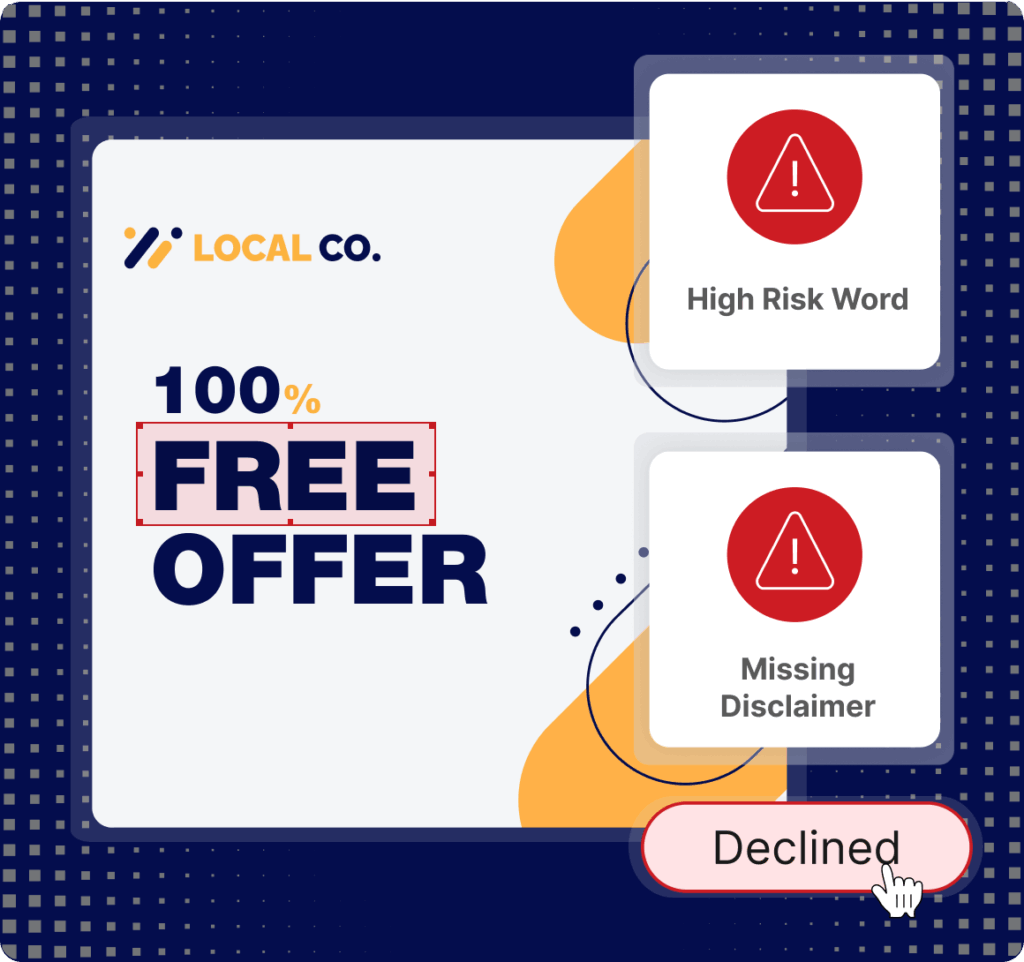
AI Powered Content Reviews – IntelligenceBank’s automated marketing risk detection is a rules-based capability that leverages AI when checking content when you are proofing and approving content. Based on a company’s specific disclaimers, PDS statements, marketing checklists, industry regulations and brand rules, (which account for approximately 80% of all legal and compliance marketing markups); the AI rules show you in a consistent manner where the problems are in the creative, and importantly how to fix it. More and more we are also seeing clients use this for checking content for negative tones, brand tone of voice, and checking for greenwashing.
Creative Templates – automate the production of creative so it’s not only on brand but uses only the correct disclaimers and approved creative assets that are appropriate for the product that is being advertised. This means not only do brands save on production and agency costs, but it also enables teams to quickly produce thousands of assets in a minimal amount of time that legal don’t need to review, as the headlines, images and disclaimers are already pre-approved.
Disclaimer Engine – can be a stand alone capability your team can use to check which disclaimers should be used by product, state, and media type, or can be fully integrated within your online creative briefs. However your team uses this capability, the main thing is they are using the right disclaimers before they start the creative, which ultimately saves your legal team a lot of time, and of course they can be double checked at the proofing stage with the AI rules.
Advanced Reporting – having advanced ‘business intelligence’ quality reporting and interactive dashboards at your fingertips to report in detail on which campaign briefs and creative assets were approved by whom, and when are essential for internal audits and reporting. Reporting also helps you identify bottlenecks such as where approvals are getting stuck and how to optimize processes.
How Different Roles Benefit From Marketing Compliance
Marketing compliance software helps each team involved in getting content approved, but in different ways.
For Marketing Leaders (CMOs)
- Faster time to market: Automated checks remove the review bottlenecks that hold up campaign launches.
- Less back-and-forth with legal: Consistent, agreed rules mean fewer debates about what is and isn’t allowed, so marketing can focus on strategy.
For Legal & Compliance Teams (CLOs and CCOs)
- Automated risk detection: AI flags potential legal and regulatory issues against your own rules, disclaimers and industry regulations before content reaches you.
- Fewer, cleaner submissions: Marketers pre-check their work, so the content you review is already mostly compliant.
- Oversight and audit readiness: You can monitor content across all channels in one place and produce approval reports for internal audit or regulators in minutes.
For Creative Teams (Designers and Copywriters)
- Real-time feedback: Compliance alerts appear while content is being created, not after it’s submitted, which cuts rework.
- Clear boundaries: Defined rules take the guesswork out, so creatives can experiment with confidence.
For Executive Leadership (CEOs and CFOs)
- Lower cost and risk: Fewer fines, lower legal fees and less reliance on manual review as content volume grows.
- Stronger governance: A clear audit trail shows the board, investors and regulators that you’re managing risk properly.
How to Calculate the Return on Investment (ROI) of Marketing Compliance?
For companies reviewing a high volume of content against brand, legal, and regulatory requirements, the ROI is often clear. The more complex the content (e.g., long-form materials with frequent updates and variable compliance rates) and the more approval layers involved, the greater the potential ROI.
Large organizations such as major banks, asset managers, broker-dealers, automotive finance firms, and insurance companies typically see significant benefits. Consistently ‘getting it right’ is challenging, and as content volume grows, scaling a manual legal and compliance review process becomes financially unsustainable.
To calculate the ROI of marketing compliance, IntelligenceBank has created a return on investment calculator to help brands decide if they have the volume of creative collateral that warrants an investment in marketing compliance software.
Key information
These calculators provide an estimate based on key inputs you provide and expected performance improvements. We use industry benchmarks and typical use case scenarios to help you get a general idea of the value our solution could deliver. The figures generated are estimates only and assume a 15% increase in content production per year. Actual cost savings can vary based on a wide range of factors unique to your business and can only be determined after a detailed understanding of your needs and the development of a tailored solution.
Marketing Compliance ROI in Action
There’s nothing like a living breathing Marketing Compliance execution to demonstrate capability and ROI. Here are just a few of our success stories.
Angle Auto Finance – Fast-growing non-bank lender
Angle Auto Finance faced a critical challenge: How to enable 800+ dealerships to customize marketing materials without overwhelming their small compliance team.
By implementing IntelligenceBank’s AI-powered compliance Content and Web Reviews, they automated approvals, reducing manual reviews to just two minutes per asset and scanning 1.6 million pages annually for risks. The solution (which was deployed in 30 days) saved 20,700 work weeks (equivalent to 400 years!). Dealers gained a self-service hub for instant feedback, and Angle Auto now proactively monitors content with AI-driven scans. As Rebecca Henderson, Angle Auto Finance’s Head of Marketing, noted, manual processes would have “blown us up”. With automated compliance, they achieved scale, speed, and regulatory confidence without sacrificing growth. Click here for the full case study.
Tabcorp – One of the world’s largest wagering companies
Tabcorp operates across various Australian states and territories, each with its own complex and ever-changing marketing regulations. Faced with the daunting task of producing over 9,500 compliant assets for high-stakes campaigns like the annual Spring Racing Carnival, Tabcorp turned to IntelligenceBank to revolutionize their workflow and compliance processes. The solution empowered their teams with self-serve templates, allowing non-designers to generate legally approved marketing materials in just 20 minutes – a process that previously took up to 10 days. With 150+ dynamic templates and an AI-powered Disclaimer Engine that automatically applies jurisdiction-specific fine print, Tabcorp eliminated compliance errors while slashing creative workloads by 30%. The platform’s centralized approval system and version control not only ensured brand consistency but also transformed their relationship with legal teams, as Senior Marketing Ops Manager Chris Yates notes: “We weren’t always friends with legal – they love us now.” Beyond efficiency gains, the system reinforced Tabcorp’s commitment to ethical marketing in a heavily regulated industry and proved that automation and compliance can coexist at scale. For more information on this solution click for the full case study.
Golden Charter – Large financial services firm
Operating in the UK’s tightly regulated financial services sector, Golden Charter faced a critical challenge: ensuring FCA compliance across a sprawling network of over 800 independent partners and 12,000+ web pages. Manual monitoring was impractical as it required an unsustainable amount of resources.
To solve this, Golden Charter partnered with IntelligenceBank to automate continual reviews of all partner content that allowed them to proactively identify and mitigate compliance issues in real time. This eliminated the need for labor-intensive manual reviews, saving 52 FTE weeks annually, (equivalent to a full-time employee’s workload), while ensuring adherence to strict FCA financial promotion rules.
On top of operational efficiencies, the solution strengthened Golden Charter’s brand integrity and consumer trust. By guaranteeing consistent compliance across their entire partner network, they were able to reduce regulatory risk by implementing a scalable, future-proof system that turns compliance from a challenge into a competitive advantage. To find out more about this implementation click the full case study.
Bottom Line: Compliance is a Competitive Advantage
Marketing compliance isn’t just a legal requirement. It’s how brands build trust, protect their reputation and avoid costly penalties. As content volumes grow, embedding compliance into the tools marketers already use makes campaigns faster, more consistent and easier to audit.
Platforms like IntelligenceBank have the ability to transform compliance from a cost center into a profit-protecting powerhouse, delivering measurable ROI through cost avoidance, efficiency gains and revenue protection.
For leadership teams, the equation is clear – Compliance technology is an investment in growth, agility, and trust. In regulated industries, the brands that win will be those who automate compliance to move faster, safer, and smarter.
Ready to prove your ROI? Contact us for a deeper discussion.