Marketers sit firmly up there with scrum geeks, acrobats, ninjas, and cats when it comes to their ability to be agile. But what is Agile Marketing? Are you already doing it but didn’t realize it was a thing? And if you’re not using Agile Marketing principles, we show you why incorporating them using the right tools can shake up your campaign management style for the better.
Why was Agile marketing developed?
Traditional marketing project management models are predominantly linear and often slow to adapt to change. This is not only frustrating for marketers, but also results in brands missing out on maximizing opportunities that present themselves throughout the year.
The Agile Marketing Concept Explained
Inspired by the agile practices used by IT professionals, a group of marketers devised a new approach to marketing project management. In 2012 they released the Agile Marketing Manifesto which is made up of five values that then expand out to ten principles. They are designed to simplify and free marketing teams up so they can move fast, be adaptable, collaborative, test, learn from facts and move on. The focus is always on the outcome for the customer and the business rather than flexing a volume of perfect work that took all year to approve.
Simply put, Agile Marketing is an operating model that lets inter-connected teams make smart decisions faster. It facilitates rapid optimization of the conversion funnel and continual feedback and measurement.
Agile Marketing is also an attitude. It encourages front footed, open-minded thinking that values action over perfection. And just because it’s fast doesn’t mean it’s loose. Quite the opposite. Most organizations will have a central online hub with Agile Marketing Tools to create, store, and channel workflow from planning to analysis of results.
Agile marketing in practice
In contrast to the way marketing has been done traditionally, Agile Marketing shortens delivery cycles and creates feedback loops that inform continuous improvement.
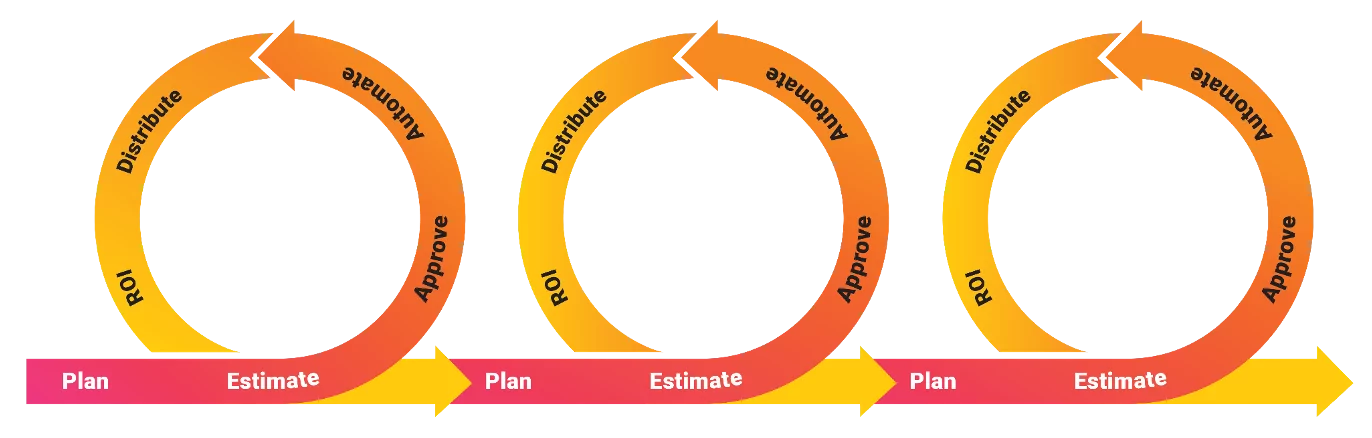
By working in short cycles, constantly testing and learning along with being open to change, you can stay ahead of the curve and keep your marketing strategy not only relevant but effective.
Agile Marketing also encourages collaboration between cross-functional teams with frequent iterations and continuous feedback. This approach breaks down internal fiefdoms and the ‘silo’ mentality by leveraging skills and sharing resources and knowledge.
In theory this is great model – perfectly suited to the hectic pace of today’s marketing environment. However in practice, without a system of record like IntelligenceBank things can move quickly from hectic to chaotic.
We owe a lot to Agile software development methodology, but it is – respectively – an easier ride for programmers. Agile Marketing is hard. While developers can instantly see what works and what doesn’t, Marketers can’t. On top of that, most major brands have external creative teams and have made internal moves to ‘product’ tribes and squads with one marketer in a team. While this has some great benefits, the major drawback is the lack of centralized marketing infrastructure.
Without a ‘Mothership’ style marketing hub, Agile Marketing becomes counterproductive. Double ups on hours and resources, quarantined results and the frightening ease of which you can go off brand are the norm when you don’t have a common system and the right tools – just like software developers have.
Speed
The most significant benefit of Agile Marketing is improved speed to market. This is largely due to increased productivity and the ability to more easily change and prioritize work.
Growth
Agile marketing also helps you make better decisions because it forces you to constantly test and learn from feedback and data. By trying new things and measuring the results, you can quickly identify what is working and what isn’t. This iterative approach allows you to constantly improve the performance of your campaigns without having to rely on guessing or hunches.
Transparency and Collaboration
Another key benefit of Agile Marketing is that creates visibility into a team’s processes through visualized workflows such as Kanban boards. This is key when pivoting and ordering priorities.
Flexibility
An Agile process allows marketing teams to respond to market dynamics. Master briefs set the vision and strategy, while campaign briefs provide flexibility on tasks, priorities, resourcing, timelines and budget.
Learn More
If you would like to know how you can elevate your team to an Agile way of working using our Marketing Operations, BrandHub and Digital Asset Management platform, reach out to one of our experts, we have offices globally.