Your marketing content is scattered across shared drives, personal desktops, old Dropbox folders and someone’s email attachments. Your designers are recreating photography that exists somewhere. Your Marketing Compliance Team is reviewing the same or derivative content multiple times across different email threads. And nobody knows with confidence whether the campaign banner currently live on your website is the approved version or the one that was superseded three weeks ago.
This is the situation that digital asset management (DAM) software exists to solve. Understanding the full capabilities of a modern DAM platform is key to building a scalable content operations model for your organization. In 2026, DAM has evolved well beyond what even seasoned Marketing Operations leaders might expect: from a searchable file library into an AI-powered, integration-native, Marketing Compliance Software-ready content operating system that also powers end-to-end Marketing Workflows. You can explore IntelligenceBank’s platform capabilities at intelligencebank.com/platform/digital-asset-management/.
Here’s what you’ll learn:
- What a DAM is, how it works and the ROI benchmarks that make the business case
- What drives DAM pricing and what IntelligenceBank’s packages cost
- The critical differences between a DAM and SharePoint or a shared drive
- The full feature set of a modern enterprise DAM, from AI metadata to API, Content Delivery Network (CDN) and Model Context Protocol (MCP)
- How to evaluate DAM vendors on implementation quality and ongoing support
- Why Australian-based implementation support and hypercare are the variables that determine long-term adoption
- How to build an internal business case for a DAM investment
- The most common questions Australian organizations ask when evaluating DAM software
What Is the ROI of Digital Asset Management Software?
A digital asset management system is a centralized platform for storing, organizing, finding, sharing and governing marketing content — images, videos, brand files, PDFs, audio, presentations, documents, sales and PR materials and design source files. Unlike a file server or cloud storage product, a DAM is purpose-built for content operations: it automatically applies rich metadata, enforces usage rights, manages approval workflows and connects to every downstream channel where marketing content needs to land.
The business case for a DAM is straightforward once the true cost of not having one is visible. Research consistently shows that knowledge workers spend between 15 and 25 percent of their working week searching for information and marketing content. For a marketing team of ten people at an average fully-loaded cost of $80,000 per year, that represents between $120,000 and $200,000 annually in unproductive search time alone — before factoring in the cost of recreating marketing assets that exist but cannot be found, the cost of brand inconsistency in the market or the cost of a rights failure that requires emergency legal response.
IntelligenceBank’s DAM ROI review and business case builder provide a structured methodology for quantifying your specific numbers. A conservative 50% efficiency improvement on time currently spent searching for and managing marketing content typically produces a payback period of less than 12 months for organizations with teams larger than 10 people. The key ROI metrics to model include:
- Time saved searching: Reduction in hours spent per week per person finding approved marketing assets — typically the largest and most immediate source of savings
- Asset reuse rate: How often existing marketing content is found and reused rather than recreated from scratch — directly reducing photography, design and agency fees
- Marketing compliance pass rate: For regulated industries or firms with extensive brand guidelines, the percentage of content that passes a brand or marketing compliance review on first submission — reducing costly late-stage rework
- Time-to-market reduction: The compression in campaign production cycles from structured approvals and marketing content accessibility
- Rights management savings: Avoided costs from rights failures, brand inconsistency incidents and the organizational disruption of emergency content remediation
How Much Does Digital Asset Management Software Cost and What Drives the Price?
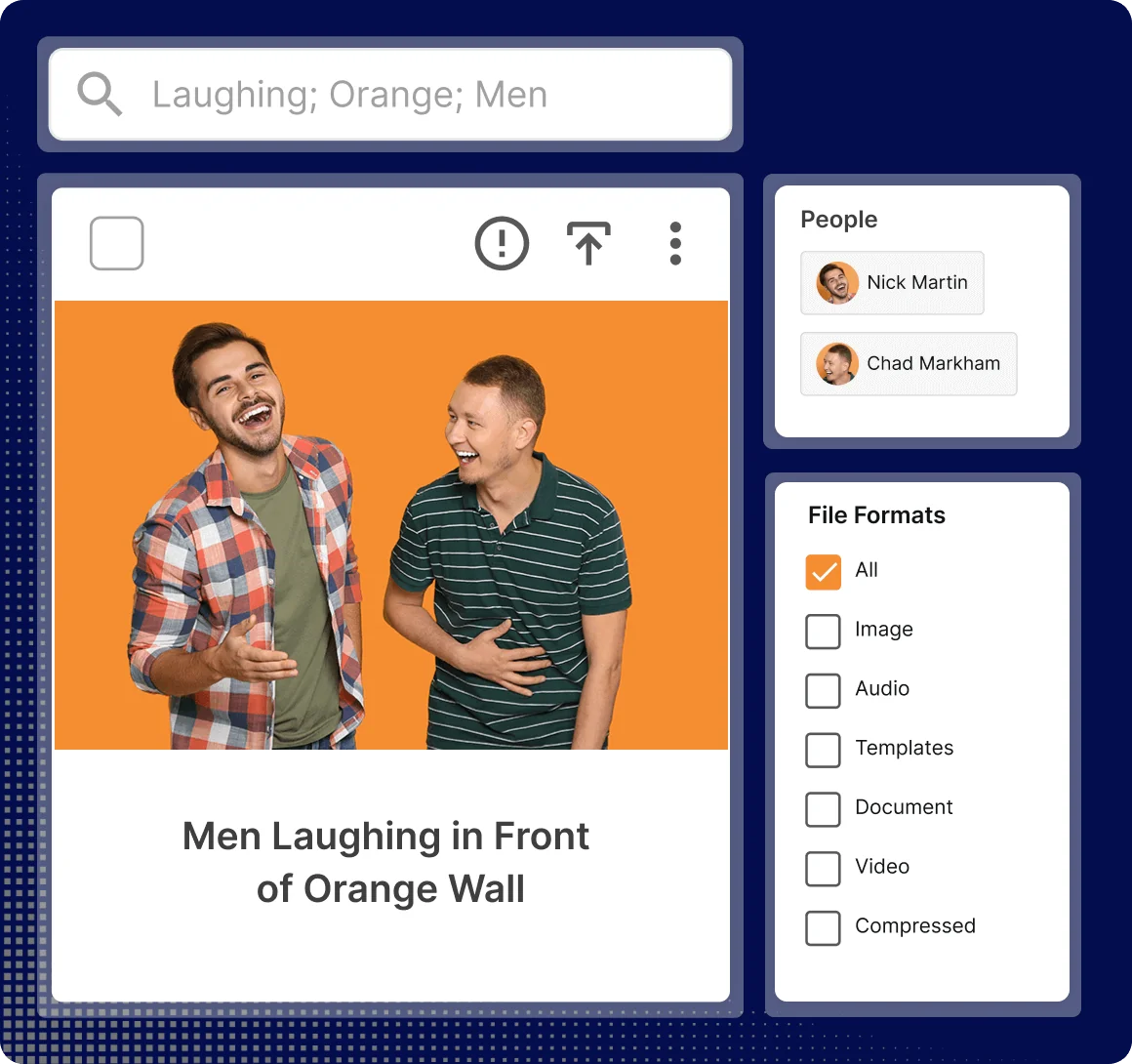
DAM pricing varies significantly — from entry-level solutions at a few hundred dollars per month to enterprise platforms whose costs scale with complexity, support requirements and data. A base digital asset management platform can be relatively inexpensive, with higher-tier packages adding briefs and intake forms, online brand pages and AI brand and marketing compliance review capabilities.
Understanding what drives the total cost is essential for budgeting accurately and avoiding the hidden-cost surprises that frequently inflate total cost of ownership. Full pricing detail is at intelligencebank.com/pricing/.
| Cost Driver | What It Means | How IntelligenceBank Approaches It |
|---|---|---|
| Storage and data volume | The volume of files stored drives infrastructure cost — particularly for organizations with large video libraries or high-resolution photography archives. | IntelligenceBank's pricing is transparent about storage tiers. CDN delivery and on-the-fly file transformation reduce storage overhead by eliminating the need to store multiple pre-rendered variants of every marketing asset. |
| Users | Most DAM platforms charge per named user, per editor seat or by user tier (admin vs. contributor vs. view-only). | IntelligenceBank offers tiered user models with different permission levels, so organizations pay for the access level Customers actually need. Light Customers who only search and download marketing assets are priced differently from power Customers who create and manage content. |
| Features and modules | Entry-level DAM packages cover search, storage and basic metadata. Advanced features — AI tagging, marketing compliance checking, advanced workflows, brand portal, Creative Templates — are priced as part of higher-tier packages or as add-ons. | IntelligenceBank's base DAM package starts from $567/month (billed annually). Higher-tier packages add Marketing Operations, BrandHub and Marketing Compliance capabilities. Every package includes core DAM functionality. |
| Implementation and onboarding | One-off implementation costs cover platform configuration, metadata taxonomy design, migration, integrations setup and training. | IntelligenceBank's implementation is led by a dedicated team with a structured methodology. Costs are scoped at the outset with no hidden implementation charges. |
| Ongoing support | Ongoing support costs vary widely. Some vendors charge separately for support tiers; others include dedicated support in the subscription. | IntelligenceBank's industry-leading support is included — with a 99% support CSAT and 9.3/10 implementation CSAT. Australian business hours support means teams get answers without overnight delays. Helpdesk support comes with every package, and IntelligenceBank offers hypercare for the first six months after launch. |
The cost of not having a DAM is almost always higher than the cost of implementing one. If 10 employees are each spending five hours per week on marketing content management tasks at a loaded hourly cost of $40, that represents $104,000 annually in direct staff cost before any agency, photography or marketing compliance failure costs are included.
What Is the Difference Between a DAM and SharePoint or a Shared Drive?
This is the question most frequently asked by procurement teams and IT managers encountering a DAM investment proposal. SharePoint is already licensed. The shared drive is already working. Why spend more?
The answer lies in understanding what SharePoint and shared drives were designed to do — and what they systematically fail to do for content operations teams. SharePoint is a document collaboration and intranet platform. A shared drive is a file storage system. Neither was designed for the operational challenges of a marketing and creative team managing thousands of marketing assets across multiple channels, external partners, approval workflows and rights obligations. They can be pressed into service for simple file storage, but the gap between what they provide and what a modern DAM provides widens dramatically with organizational scale, content volume and marketing compliance complexity.
| Capability | SharePoint / Shared Drive | Purpose-Built DAM (IntelligenceBank) |
|---|---|---|
| Marketing content discovery | Folder navigation or basic keyword search; relies on Customers naming files consistently | AI-powered semantic search with advanced filters across metadata, keywords, file type, date range, usage rights and custom fields |
| Metadata and tagging | Manual file naming and folder structure; no AI assistance | AI auto-tags images, video and audio on upload; image descriptions, audio and video transcriptions, facial recognition; custom metadata fields; bulk edit; metadata embedded into downloaded files |
| Version control | Basic version history; difficult to enforce "approved" vs. "draft" separation | Full version history with status tracking; approved marketing content clearly separated; expired or superseded versions auto-archived, with the ability to set permissions on versions and compare versions and their markup comments |
| Rights management | No native rights or expiry tracking | Usage rights fields, expiry dates that trigger automated alerts and automatic archival, talent release form linking to multiple marketing assets |
| Workflows and approvals | No structured workflow; approvals managed via email or Teams | Configurable multi-stage approval workflows with AI brand and marketing compliance pre-checks, inline proofing, parallel routing and audit trail |
| Integrations | Microsoft 365 ecosystem only | 200+ integrations: Adobe CC, Canva, Figma, CMS platforms, Shopify, Workato, Zapier, Jira, Asana, Workfront and more; full API; CDN; MCP. Microsoft 365 is also supported |
| Creative Templates | None | Editable branded templates for end Customers to tailor and download brand-approved marketing content; controlled fields so brand is always consistent |
| Marketing compliance and oversight | None | AI brand and marketing compliance checkers embedded in workflows; continuous monitoring of live websites, ads and social channels |
| Support and implementation | Internal IT project; no dedicated DAM support | Dedicated implementation team; hypercare period; 99% support CSAT; 9.3/10 implementation CSAT |
The most common outcome for organizations that try to use SharePoint or shared drives as a long-term DAM substitute is that adoption fractures: different teams develop their own workarounds, marketing assets proliferate across multiple unofficial locations, version control breaks down and the organization ends up managing the same content management problem it was trying to solve — at greater cost and complexity, because the unofficial systems are now entrenched.
What Are the Key DAM Features and Why Do They Matter in 2026?
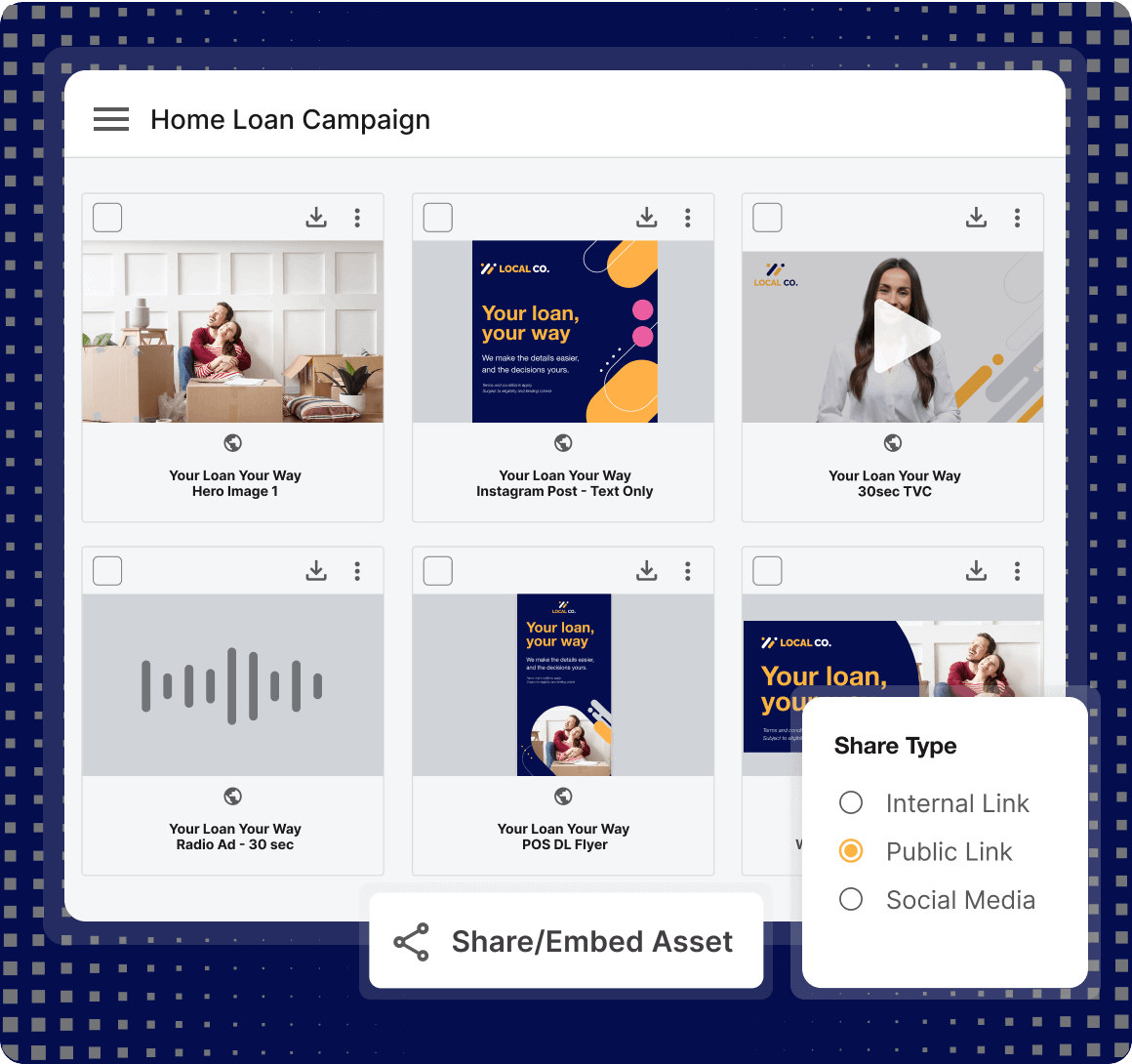
Modern DAM platforms are moving from simple file repositories to interoperable sources of truth — AI-tagged, workflow-connected, marketing compliance-aware systems that serve as the controlled hub of the entire marketing technology stack. The table below maps the key feature areas of a modern enterprise DAM, what they do and why they matter in the 2026 content environment.
| Feature Area | What It Does | Why It Matters in 2026 |
|---|---|---|
| AI metadata tagging | Automatically tags images, video and audio on upload — identifying objects, scenes, keywords, faces and transcribing spoken word. Custom metadata fields allow organizations to define their own taxonomy. | Marketing content volumes are growing faster than the capacity to tag manually. IntelligenceBank AI tagging at upload ensures every asset is findable from day one, without depending on Customers to follow naming conventions. |
| Advanced search | Semantic search across all metadata fields, file types, date ranges, usage rights, collections and custom attributes. Saved searches, filtered views and type-ahead suggestions. | If teams cannot find marketing content quickly, they recreate it — wasting budget and introducing brand inconsistency. Advanced search is the primary productivity ROI driver of any DAM. |
| Rights management and review dates | Usage rights fields, expiry dates that trigger automated alerts and asset archival and the ability to relate a talent release form to multiple marketing assets. Review dates prompt owners to reconfirm, update or retire content. | Rights failures are expensive — both legally and reputationally. Automated expiry management prevents out-of-rights marketing assets from remaining in circulation after licenses lapse. |
| Approval workflows with AI marketing compliance | Configurable multi-stage workflows with AI brand and marketing compliance pre-checks. AI checks for correct tone of voice, logo usage, editorial guideline adherence and banned imagery. Parallel routing, inline proofing and time-stamped audit trail. | Manual approval via email loses versions, misses marketing compliance issues and creates no oversight record. Structured workflows with AI pre-checks catch issues early and compress approval cycles to hours rather than days. |
| Creative Templates | Editable branded templates for end Customers — social posts, email banners, presentations, event materials. Controlled fields ensure brand elements stay locked while content is customizable. | Templates reduce the volume of one-off creative requests reaching the design team and ensure every piece of end-Customer content is on-brand without a designer in the loop. |
| Third-party upload portals | External contributors — photographers, agencies, event suppliers — can upload marketing content directly into the DAM via a branded portal, with metadata and usage rights captured at the point of upload. | Agencies and suppliers are the source of most marketing content. A structured upload portal replaces ad hoc Dropbox transfers and ensures rights information and metadata are captured before assets enter the library. |
| API, CDN links and MCP | Full API for custom integrations; CDN links for embedding approved marketing content directly in websites and applications; Model Context Protocol (MCP) for AI-native workflow connectivity. | Modern marketing stacks require the DAM to be an active participant in every downstream system — not a silo teams visit to download files. API, CDN and MCP make IntelligenceBank the controlled source of truth across the entire stack. |
| Advanced reporting | Dashboard reports for expired assets, new files added, overdue workflow approvals, most-accessed marketing content, storage utilization and user activity. | Reporting turns the DAM from a storage tool into a managed system. Marketing Compliance Leaders, Chief Marketing Officers and IT teams each have visibility into the metrics that matter to their function. |
| Custom interfaces by user group | Different portal views for different user groups — Brand Leaders see the full library; retail partners see only their region's marketing assets; agency Customers see only active campaign content. | A single undifferentiated interface creates noise and friction. Custom views ensure every user group sees exactly what they need — improving adoption and reducing support overhead. |
How Does IntelligenceBank Integrate With Your Existing Marketing Stack?
No DAM delivers its full value as a standalone system. The companies that achieve the highest ROI from IntelligenceBank are those that connect it to the tools their teams already use — so that accessing, approving and distributing marketing content requires no additional workflow steps beyond what teams are already doing.
IntelligenceBank’s integration ecosystem covers design tools including Canva, Adobe Express, Figma, Adobe InDesign, Illustrator and Photoshop; content management system (CMS) and e-commerce platforms including WordPress, Adobe Experience Manager, Drupal, Sitecore, Contentful, Umbraco and Shopify; integration platforms including Workato and Zapier; and project management tools including Jira, Workfront, Monday.com and Asana. The full integration library is available at intelligencebank.com/integrations/.
IntelligenceBank also provides a full REST API (Application Programming Interface) for custom integrations and CDN links for embedding approved marketing content directly in web applications without downloading and re-uploading.
| Integration Category | Platforms Supported |
|---|---|
| Design tools | Canva, Adobe Express, Figma, Adobe InDesign, Illustrator, Photoshop |
| CMS and e-commerce | WordPress, Adobe Experience Manager, Drupal, Sitecore, Contentful, Umbraco, Shopify |
| Integration platforms | Workato, Zapier |
| Project management | Jira, Workfront, Monday.com, Asana |
| Custom and headless | Full REST API, CDN links, MCP |
How Do IntelligenceBank’s Approval Workflows and AI Marketing Compliance Checking Work?
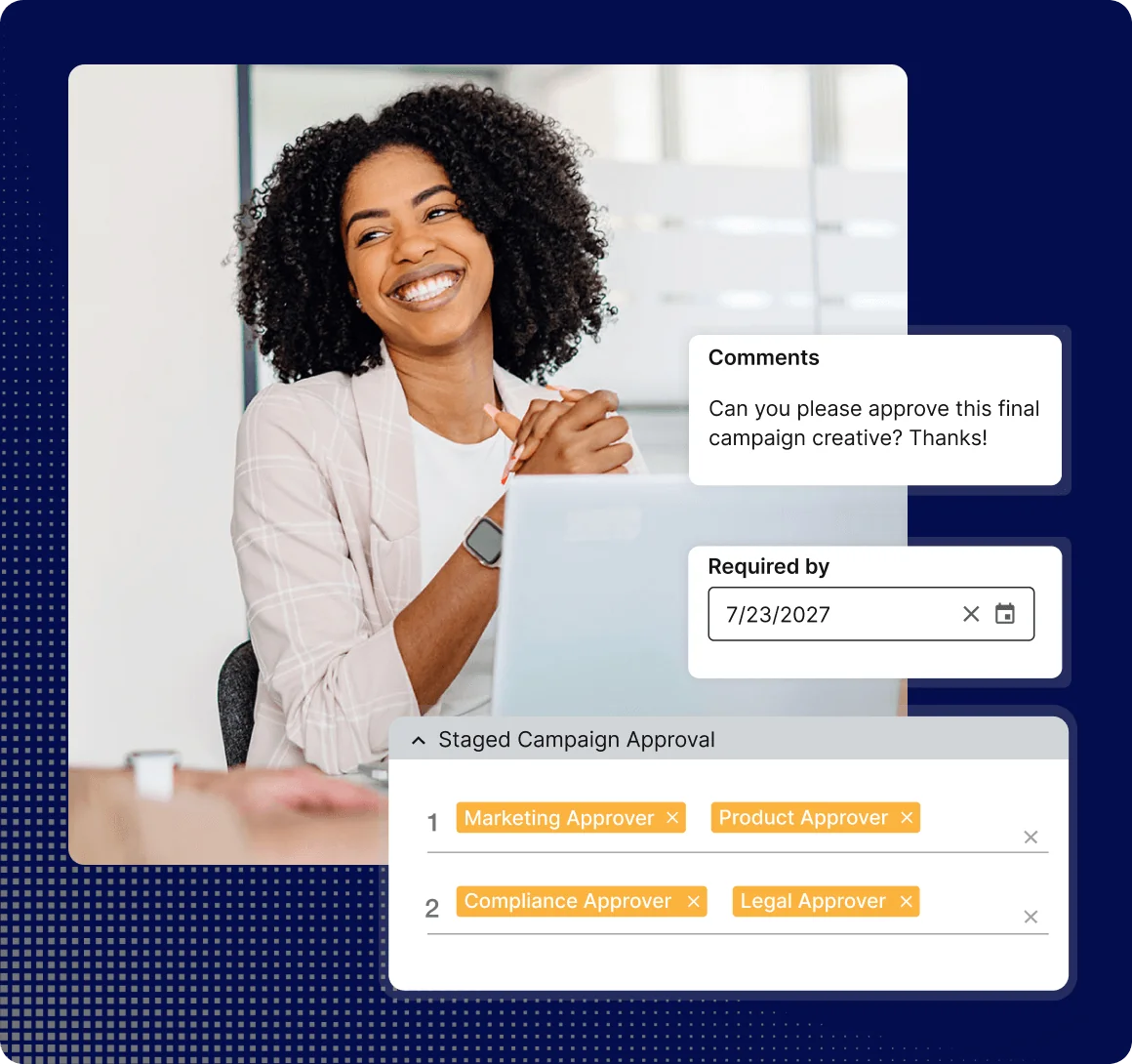
IntelligenceBank’s workflow capability goes beyond standard approval routing. AI brand and marketing compliance checkers embedded in the workflow assess marketing content for correct tone of voice, approved logo usage, editorial guideline adherence and banned imagery — before the content reaches a human reviewer. This upstream AI check means reviewers see a risk score and annotated flags on submission, so they can focus on issues that require human judgment rather than performing manual quality checks on every asset.
Workflows cover three main use cases:
- Production approvals: Approving marketing content during the production stage — the primary marketing compliance workflow.
- External content intake: Workflows to publish approved marketing assets to the DAM from external sources such as agencies and photographers.
- Controlled distribution: Workflows to process marketing asset download requests from Customers who need access to restricted or licensed content with controlled distribution.
Why Does Local Support Determine Whether a DAM Implementation Succeeds?
Every DAM vendor can demonstrate a feature-complete platform in a sales demo. The variable that actually determines whether your DAM delivers its ROI — or becomes an expensive underused system — is the quality of implementation and the ongoing support model after launch.
This is where IntelligenceBank’s Australian-based customer success and implementation teams are a material differentiator for Australian buyers. Implementation is led by a dedicated IntelligenceBank team with deep experience across a wide range of Australian industries — financial services, higher education, manufacturing, government, retail, healthcare and professional services — and a structured methodology that has been refined across hundreds of implementations. The implementation CSAT of 9.3 out of 10, measured across all IntelligenceBank customer implementations, reflects the quality and consistency of this process.
The implementation journey follows four stages outlined in detail in IntelligenceBank’s guide to DAM implementation:
- Discovery and scoping: Understanding your requirements, user groups and integrations.
- Configuration and build: Building the platform including metadata fields, workflows, permissions and brand portal.
- Testing and migration: Importing existing marketing assets with metadata and quality-checking results.
- Controlled launch followed by full rollout: Pilot release with intensive early-stage support before company-wide deployment.
| Implementation Stage | Key Activities | Outcome |
|---|---|---|
| Discovery and scoping | Requirements gathering, user group mapping, integration planning | Agreed project scope and taxonomy design |
| Configuration and build | Platform setup, metadata fields, workflows, permissions | Configured platform ready for testing |
| Testing and migration | Marketing content import, metadata mapping, quality checks | Validated library ready for launch |
| Controlled launch and rollout | Pilot release, hypercare, full deployment | Lasting adoption across the organization |
Following every launch, IntelligenceBank provides a dedicated hypercare period — typically several months — during which the implementation team provides intensive monitoring, rapid issue resolution and close Customer support. This period is critical because the habits Customers form in the first few weeks with a new system determine whether they adopt it permanently or quietly revert to the shared drive.
IntelligenceBank’s support CSAT of 99% and implementation CSAT of 9.3/10 are measured continuously across all active customers and implementations. For Australian organizations, Australian business hours support means issues are resolved by a team that understands your context — without overnight delays or offshore support queues.
How Do You Build a Business Case for a DAM Investment?
If you are evaluating digital asset management software for your company in 2026, the two most productive next steps are to formalize your requirements and to build your internal business case.
The IntelligenceBank DAM RFP Template is a comprehensive, editable document that covers business goals, technical requirements, user needs, security and marketing compliance, integration capabilities, pricing, ROI and vendor support. It can be applied to any DAM vendor and is designed to give you a structured framework for comparing responses side by side — so you are evaluating vendors against the same criteria, not comparing feature lists from different vendor brochures.
The DAM Business Case Builder walks you through the process of quantifying your current cost of content chaos and projecting the savings a DAM will deliver — producing a formatted business case document ready to present to a CFO, CTO or executive committee. It is designed to move the conversation from “we need better file management” to “here is the financial case for investing $X to save $Y annually.”
Both resources are available to download from intelligencebank.com. And if you are ready to see IntelligenceBank in action for your specific use case, our Australian team is available for a tailored demonstration.
Digital Asset Management Software FAQs
How long does it take to implement a DAM?
Implementation timelines vary depending on the size of your marketing content library, the complexity of your metadata taxonomy and the number of integrations required. For most organizations, IntelligenceBank can be configured and ready for launch within 7 to 90 days depending on complexity. IntelligenceBank’s implementation team manages this process end-to-end, and a dedicated hypercare period following launch provides intensive support while teams bed in the new system.
Where are marketing content, images, video and data stored?
IntelligenceBank is a cloud-based SaaS platform. Marketing assets are stored in enterprise-grade cloud infrastructure with data centers available in Australia, the United States, the European Union and other regions depending on data sovereignty requirements. Australian customers with data residency requirements can elect to have their marketing content stored in Australian data centers (AWS Sydney). IntelligenceBank’s infrastructure is ISO 27001-certified and designed to enterprise security standards including at-rest and in-transit encryption, role-based access controls and comprehensive audit logging.
How do I migrate existing marketing content into IntelligenceBank?
IntelligenceBank provides a structured migration methodology designed to bring your existing marketing assets — from shared drives, Dropbox, Google Drive, legacy DAMs or other storage systems — into the platform with metadata intact. The migration process typically involves an audit of your current marketing content inventory and folder structure; mapping of existing folder names and file metadata to your new IntelligenceBank taxonomy; bulk upload via IntelligenceBank’s migration tools; post-migration quality checking; and AI auto-tagging of any marketing assets that arrive without sufficient metadata. A “big bang” migration is not required — you can continue to add marketing content progressively after launch.
How do I drive adoption of a new DAM platform?
DAM adoption is as much a change management challenge as it is a technology one. Practical drivers of adoption include ensuring the DAM is accessible from the tools teams already use through integrations with Microsoft 365, Canva, Adobe Creative Cloud and your CMS; making it easier to find marketing content in the DAM than to search a shared drive or ask a colleague; training champions in each team who can support their colleagues day-to-day; and using IntelligenceBank’s usage reporting to identify which teams or user groups are not engaging and intervening early. IntelligenceBank’s implementation team includes change management guidance as part of the standard delivery.
How is IntelligenceBank different from other DAM vendors?
IntelligenceBank is the only platform that combines enterprise-grade digital asset management with fully integrated marketing compliance software and marketing workflow — in a single platform, with a shared data model and a unified approval workflow. Where most DAM vendors focus on storage, search and distribution, IntelligenceBank extends into AI-powered marketing compliance checking at the point of creation inside Word, PowerPoint, Figma and Canva; structured approval workflows with risk scoring and inline markup; post-publication monitoring of live websites and ad channels; and a brand portal and Creative Templates capability that empowers end Customers to produce on-brand marketing content without always going through the design team. IntelligenceBank is ranked #1 across seven G2 categories including asset management, workflow management and likelihood to recommend — as evidenced in the G2 Digital Asset Management Vendor Comparison Report.
What is the difference between a DAM and a CMS?
A content management system (CMS) is designed to manage and publish web content — typically structured around pages, templates and publishing workflows for a website or digital platform. A DAM is designed to manage the underlying marketing assets that populate that content: images, videos, PDFs, brand files, documents and creative assets across all channels, not just the web. In practice, most organizations need both — the DAM serves as the controlled source of truth for all approved marketing content and integrations push the right assets to the CMS at the point of publication. IntelligenceBank integrates natively with leading CMS platforms including WordPress, Adobe Experience Manager, Drupal, Sitecore, Contentful, Umbraco and Shopify.
If you’re ready to bring your marketing content under control and give your team a single, approved source of truth, contact us for a demo.
Disclaimer: Pricing information is current as at June 2026 and subject to change. Contact IntelligenceBank for a tailored quote based on your specific requirements. All ROI examples are illustrative and based on typical customer results — actual savings will vary by organization.
*Modern workplace data indicates that knowledge workers continue to face severe information silos, spending between 1.8 and 2.5 hours every day — roughly 22% to 31% of their active workday — searching for critical information and marketing content (PR Academy, 2025).