Learn how AI is transforming digital asset management in 2026 — from intelligent metadata and agentic automation to compliance-embedded workflows and API-first architecture — and how IntelligenceBank is leading the shift from passive content management to active marketing infrastructure.
Digital asset management (DAM) is the practice of organizing, storing and distributing an organization’s marketing content in a single, permission-based, searchable platform. This includes everything from product images, campaign videos and brand guidelines to PDFs, ads and social media assets. In 2026, AI is fundamentally expanding what DAM software can do — moving it from a storage library to a governed content operating system that actively supports the entire marketing content lifecycle.
For enterprise marketing teams producing hundreds or thousands of assets per month, across dozens of channels and with complex approval requirements, the questions that matter have shifted. It is no longer enough to ask where an asset is stored. The question is: can the right person find the right approved, brand- and legally compliant file, and can it reach its destination without manual intervention? This guide covers the seven defining trends reshaping enterprise DAM in 2026 and explains how IntelligenceBank is purpose-built to address each one.
Here’s what you’ll learn:
- Why the role of the DAM has fundamentally shifted from storage library to governed content operating system
- The defining AI and DAM trends reshaping enterprise marketing operations in 2026
- How AI auto-tagging, object recognition and facial recognition transform asset discoverability at scale
- Why compliance-embedded DAM is the new standard and what it means for regulated industries and all brands
- How agentic AI is changing what DAM platforms can automate
- Why MCP and API-first architecture matters for AI-native marketing teams
- How IntelligenceBank’s unique combination of DAM, compliance and workflow delivers capabilities that is transforming the Digital Asset Management industry
What Is Happening to Digital Asset Management in 2026?
Digital asset management has been evolving for two decades. But 2026 represents something qualitatively different from previous cycles of change. The shift is not simply that DAM platforms are adding AI features. AI is changing both the importance and the role of DAM systems, with DAM’s emphasis on categorization and a single source of truth for approved marketing content.
Traditionally, DAM software solved the problem of content sprawl and disorganization — scattered folders, duplicated assets, version confusion — by centralizing everything in one permission-based searchable library. That is useful, especially as digital content continues to explode in volumes and variants. But for enterprise marketing teams producing hundreds or thousands of assets per month, across dozens of channels, in multiple languages, with complex approval requirements, a searchable file library is necessary but nowhere near sufficient.
The capability that AI-powered DAM platforms are now expected to provide is: how can a user find the right file that is approved and is brand, legal and regulatory compliant; and can it be distributed to where it needs to go without manual intervention? That is a radically different brief from DAM’s traditional metadata management and search core use cases.
Based on IntelligenceBank DAM’s user base, over the past 5 years, digital content has experienced double-digit annual growth. This has been driven by channel proliferation, personalization requirements and the rise of AI-assisted content generation. A major brand that produced 1,000 creative assets per month in 2020 may be producing 8,000 or more in 2026. For brands in regulated industries such as financial services, insurance, healthcare, gaming and government, the marketing compliance complexity and potential bottlenecks that occur around that content has grown in parallel. Manual workflows can no longer bridge the gap. AI-powered DAM is the infrastructure that does.
According to Tessa Court, CEO of IntelligenceBank: “The strategic shift is happening now, from DAM Software being thought of as a static repository to a dynamic system-of-record — where an AI-powered DAM provides not just storage and search, but governed, auditable, compliance-ready interoperable infrastructure for the entire content supply chain.”
What Are the Key Defining DAM Trends for 2026?
The following table summarizes the seven trends reshaping enterprise DAM in 2026 and maps each to specific IntelligenceBank capabilities.
| Trend | What It Means in Practice |
|---|---|
| AI-Powered Metadata and Discoverability | Auto-tagging, facial recognition, automatic descriptions, audio/visual transcriptions and object recognition mean assets are findable in seconds without manual cataloguing. |
| DAM as Compliance Infrastructure | Assets are approved based on custom brand, legal and compliance risks tailored to your products, brand guidelines and risk appetite. AI marketing compliance rules check content being approved before it goes into the DAM as an embedded feature. |
| Agentic AI and Content Automation | AI agents take on routine content tasks — resizing, reformatting, tagging, compliance pre-checks via integrations — freeing teams for higher-value work. |
| Integration-First Architecture (MCP/API) | DAM must connect to every tool in the marketing stack — not require teams to leave their existing workflows to access assets. Robust integrations with web content management, design tools, project management tools and document creation tools are a must. |
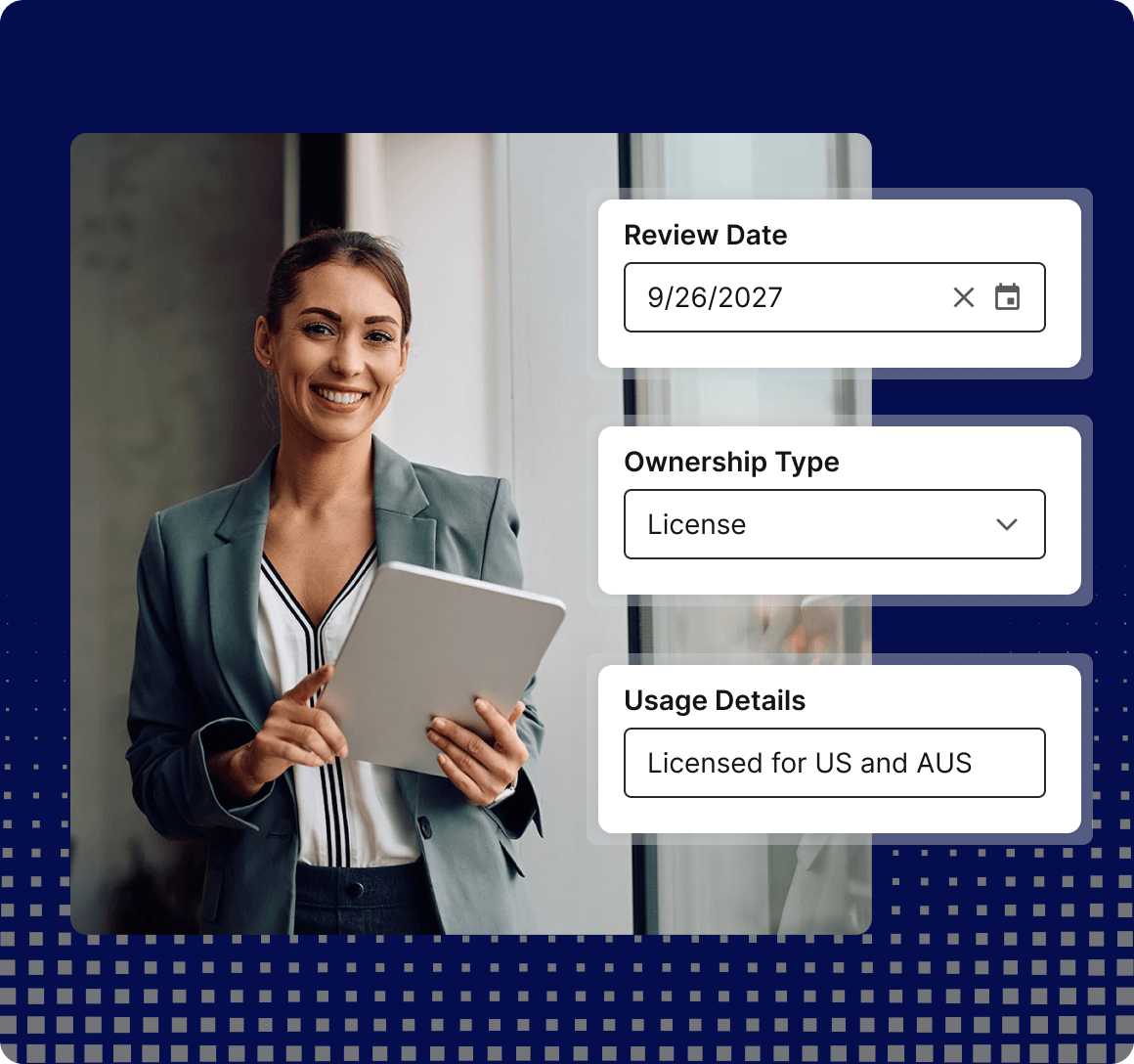
| Rights, Permissions and Content Oversight at Scale | As asset volumes grow, managing who can access and use what — and tracking expiries — becomes operationally critical. A workflow process around talent usage rights sign-off, AI facial recognition and expiration dates ensures imagery of customers, employees and actors adheres automatically to usage agreements. |
| Post-Publication Content Monitoring | Approved assets published to websites, ads and partner channels must stay compliant after they go live. IntelligenceBank's post go-live AI risk checkers scan websites, social media channels, digital ad networks and partner channels to ensure all messaging is on brand and legally compliant over time. |
| Content Transformation at Source | Teams need approved assets in the right format and dimensions for every channel without going back to the design team. Digital asset transformation automates the conversion of assets on the fly to different sizes, formats and smart cropping. |
DAM Trend 1: How Is AI-Powered Metadata Making Marketing Content Actually Findable?
Ask any marketing team what their biggest frustration with their DAM is and the answer is almost always the same: they cannot find what they are looking for. Not because the assets do not exist — they do, often in enormous volumes — but because the metadata is incomplete, inconsistent or missing entirely. Manual tagging disciplines break down under volume. Assets uploaded in haste get generic names and no metadata. Six months later, nobody can find them.
AI auto-tagging solves this at source. IntelligenceBank’s AI automatically analyzes and tags images, video and audio assets on upload — identifying objects, scenes, themes, brands and locations without any human input. It also automatically describes images that then feed into the search. The result is a content library that produces reliable, specific results in seconds rather than requiring a human to hunt through folder structures or rely on another team member’s memory of where something was saved.
Beyond basic object recognition, IntelligenceBank delivers capabilities that matter specifically for enterprise content management:
- Facial recognition: Identifies specific people across thousands of assets and links them to talent release forms — ensuring only cleared talent appears in published content and that usage rights expiries are tracked automatically rather than managed in a spreadsheet.
- Duplicate detection: Catches identical or near-identical files as they are uploaded, preventing the library bloat that makes DAMs progressively less usable over time.
- Custom metadata mapping: Allows organizations to define their own metadata taxonomies and have AI populate those fields consistently so that assets conform to internal classification standards rather than generic AI categories.
- Embedded metadata: IntelligenceBank embeds metadata directly into asset files, meaning that metadata travels with the file even when it is distributed outside the platform.
The practical outcome for enterprise marketing teams is that time spent looking for assets — a cost that is routinely underestimated in DAM business cases — is dramatically reduced.
DAM Trend 2: How Is Marketing Compliance Moving Inside the DAM?
The most significant structural shift in enterprise DAM in 2026 is that marketing compliance is becoming a native function of the platform, not a downstream process that happens after creative is finished. For brands operating at scale, this shift is not optional. It is an operational necessity.
The traditional marketing compliance model — where content is produced, then handed to legal or compliance teams for review, then revised, then re-reviewed — is too slow for the pace at which modern marketing teams operate. It creates bottlenecks that delay campaigns and concentrates marketing compliance risk in a single late-stage gate, which means issues discovered at review require expensive rework. And it provides no protection against compliance drift in content that has already been published but is no longer current.
IntelligenceBank’s approach embeds AI marketing compliance and custom risk detection at every stage of the content lifecycle — inside authoring tools such as Canva, Microsoft Word, PowerPoint and Figma; inside the approval workflow where AI comments run alongside the proofing and review process, intermingled with human comments and markups; and continuously monitoring live content after publication to ensure content out in the world is on brand and legally compliant. This is what distinguishes a compliance-integrated DAM from a repository with a marketing compliance module bolted on.
IntelligenceBank uses a combination of deterministic risk rules — for non-negotiable requirements like mandatory disclaimers and disclosures — and AI agents, which catch more nuanced, contextual risks such as misleading tone, greenwashing language and inappropriate urgency-driven copy. The result is more accurate reviews that give marketing compliance teams confidence, not doubts, with a human always in the loop.
DAM Trend 3: How Is Agentic AI Changing What DAM Platforms Can Automate?
Agentic AI — AI that can take sequences of actions autonomously rather than simply responding to individual queries — is the frontier of what DAM platforms can deliver in 2026. Where previous generations of DAM AI were primarily analytical (this asset has these attributes, this content contains this risk), agentic AI is operational: it takes actions, executes workflows and handles tasks end-to-end within defined boundaries.
For enterprise marketing teams, the practical implications are significant. Tasks that previously required a human hand at every step — downloading an asset, resizing it for a specific channel, checking it for marketing compliance, routing it for approval, distributing it to the right destination — can increasingly be handled by AI agents working within the DAM platform, with humans reviewing outputs and making strategic decisions rather than performing mechanical steps.
IntelligenceBank’s AI capabilities reflect this shift. Automated marketing compliance checks run without human initiation. Duplicate detection fires on upload. Facial recognition and rights-linking happen as assets enter the library. Asset description generation produces searchable, accessible metadata for every file without manual input. These are not features that require a human to trigger them — they operate continuously, in the background, at production scale.
The principle that makes agentic AI viable in regulated industries is equally important: human oversight remains mandatory and AI operates within clearly defined guardrails. IntelligenceBank’s model is explicit about this — AI-powered review is the first line of detection, but a human reviewer always has the final say before content is approved or published. This human-led, AI-powered model is the right architecture for organizations where the consequences of a marketing compliance failure are regulatory, reputational or financial.
DAM Trend 4: How Is MCP and API-First Architecture Making the DAM the Hub of the Marketing Stack?
For most of DAM’s history, the challenge of integration was a friction point rather than a strength. Getting assets from the DAM into the tools where work actually happened — design applications, CMS platforms, marketing automation systems, social media management tools — required downloads, uploads and manual file management that undermined the efficiency gains the DAM was supposed to deliver.
API-first architecture changed that. And the emergence of Model Context Protocol (MCP) as a standard for connecting AI tools to data sources and applications is changing it again — this time for AI-native workflows. MCP allows AI assistants and agents to query, retrieve and interact with DAM content directly, within the tools where users already work, without requiring them to navigate to the DAM itself. The DAM becomes not just an archive but an active participant in AI-powered content workflows.
IntelligenceBank’s integration architecture is built for this model. Hundreds of out-of-the-box workflow integrations connect the platform to Adobe Creative Cloud, Canva, Microsoft 365, Google Workspace, Salesforce, CMS platforms, marketing automation tools and more. A configurable API handles custom integrations for organizations with specific requirements. And MCP server connectivity (beta) positions IntelligenceBank for AI-native workflows where agents and assistants need direct, controlled access to approved assets.
The strategic implication is that the DAM stops being the repository and instead becomes infrastructure — a controlled source of truth that feeds every downstream content channel and tool rather than a place teams have to visit to retrieve files. For enterprise marketing operations, this is the difference between a DAM that reduces friction and one that actively accelerates how content reaches the market.
DAM Trend 5: How Are Rights Management and Permissions Becoming Mission-Critical at Scale?
As content volumes grow and distribution channels multiply, the rights management question — who is allowed to use which asset, for which purpose, in which market, until when — becomes exponentially more complex. For enterprise organizations with large libraries of photography, video and design assets, rights management that depends on human memory or spreadsheet tracking is a liability, not a system.
The risks are concrete: an image of talent whose contract expired six months ago reappearing in a paid social campaign; a photograph licensed for use in Australia being used in a US campaign where the license does not apply; an asset with a geographic restriction being distributed globally through an automated channel without anyone noticing. These are not hypothetical scenarios — they are the kinds of rights failures that generate both legal exposure and significant cost.
IntelligenceBank addresses this with AI-assisted rights management that operates at the asset level. Facial recognition identifies every appearance of a specific person across the entire asset library and links those assets to corresponding talent release forms, consent records and usage rights. When a release expires, the platform can flag or restrict access to affected assets automatically. Usage expiry alerts and advanced reporting ensure that assets with time-limited licenses are flagged and automatically archived within the DAM before they are used in new campaigns — not after a rights holder has raised an infringement claim.
Access controls ensure that assets are visible and usable only by the teams and markets that have permission, with rights-aware distribution preventing assets from being shared outside their licensed scope. Combined with full version history and a complete audit trail of every access and download, IntelligenceBank’s rights management infrastructure gives companies the evidence they need to demonstrate rights compliance — not just the intention of it.
DAM Trend 6: How Is Content Transformation at Source Eliminating the Channel Production Bottleneck?
One of the most persistent inefficiencies in enterprise content operations is the gap between an approved master asset and the channel-ready variants needed to deploy the content. An approved hero image for a product launch needs to be reformatted as a LinkedIn banner, a Facebook post, a website hero, a display ad in six sizes and a print-ready version for retail. Traditionally, each of these variants required a request to a designer, a turnaround time and a separate round of review.
IntelligenceBank addresses this directly with in-platform content transformation capabilities. Images can be converted between file formats and cropped to channel-specific dimensions without leaving the platform. Video footage can be clipped to produce shareable snippets. Pre-set size templates apply standardized crops automatically, producing all required variants from a single approved master in minutes rather than days.
The marketing compliance implication is equally important: because variants are produced from the approved master within the controlled platform environment rather than by downloading a file and editing it externally, the lineage from approved master to published variant is maintained. There is no risk of an unapproved version of an asset entering distribution through an informal editing workflow outside the DAM.
DAM Trend 7: How Is Post-Publication Monitoring Closing the Last Gap in Content Management?
The final frontier of content management in 2026 is the gap between content approval and content retirement. Traditional DAM and marketing compliance processes treat publication as the end state — once content is approved and live, the marketing compliance function moves on. But for brands operating at scale, with content distributed across owned websites, partner networks, social channels, paid advertising and third-party platforms, the post-publication landscape is where compliance drift is most likely to occur and least likely to be detected.
Product terms change. Offers expire. Regulatory requirements are updated. A promotion that was accurate and compliant on its launch date may, three months later, contain an outdated rate, a discontinued offer or a claim that no longer reflects the product’s current features. Without systematic monitoring, this drift is invisible — until a customer complaint, a regulator’s inquiry or a competitor’s challenge brings it to light.
IntelligenceBank’s continuous post-publication monitoring uses AI to scan live digital channels at scale — a company’s own websites, Google Ads, social media channels, partner portals and distributor landing pages — flagging content that presents brand, legal or regulatory risk. Alerts are generated in real time, enabling marketing compliance teams to act before non-compliant content causes harm. For organizations with large partner or franchise networks, this is the capability that closes the last management gap — ensuring that the marketing compliance standard applied to internally produced content extends to the full distribution network.
How Does AI-Powered DAM Compare to a Traditional Repository?
For companies evaluating whether to move from a legacy DAM to an AI-powered platform, the comparison below illustrates the capability gap across eight dimensions.
| Capability | Traditional DAM | AI-Powered DAM (IntelligenceBank) |
|---|---|---|
| Asset discovery | Manual folder navigation or keyword search | AI auto-tagging, object recognition, face recognition and semantic search across millions of files in seconds |
| Metadata management | Manual tagging by administrators | AI generates rich metadata on upload; custom fields mapped automatically; metadata embedded into files |
| Marketing compliance review | Manual legal review after production | AI risk detection inside authoring tools (Word, PowerPoint, Figma, Canva), during the proofing and review process and continuous post-publication monitoring |
| Rights management | Spreadsheet tracking or manual notes | Linked talent release forms, automated usage expiry alerts, rights-aware access controls and AI facial recognition with in-app training |
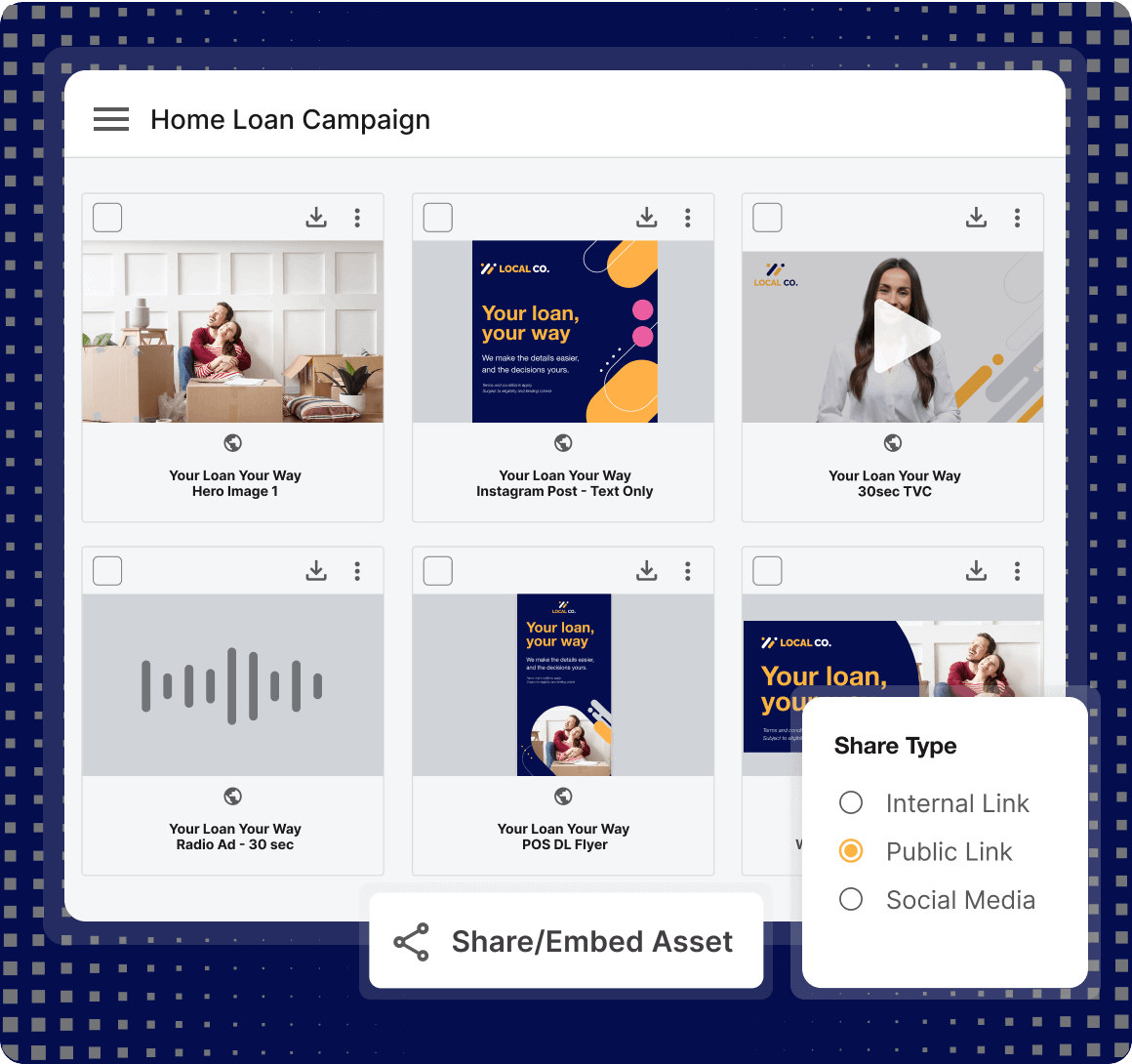
| Content transformation | External tools; design team requests | In-platform conversion, cropping, video clipping and pre-set size templates produce variants instantly to be downloaded or delivered via a public CDN link |
| Approval workflows | Email chains and shared drives | Structured parallel workflows with AI risk scoring, inline annotations and a time-stamped audit trail with advanced reporting |
| Partner management | Ad hoc manual audits | Continuous AI monitoring of partner and distributor sites, ads and social channels for brand and marketing compliance risks |
| Integrations | Limited, often siloed | Hundreds of pre-built integrations plus configurable API and MCP connectivity for AI-native toolchains |
What Makes IntelligenceBank Different from Other DAM Platforms?
Most DAM platforms offer some version of AI tagging and integration capability. What differentiates IntelligenceBank is the depth and integration of its marketing compliance layer — a capability set that no repository-only DAM platform can replicate, because it requires years of investment in AI risk detection, regulatory rule libraries and workflow architecture specifically designed for regulated industries.
IntelligenceBank is the only platform that combines enterprise-grade DAM with fully integrated marketing compliance software and marketing workflow — in a single platform, with a shared data model, a unified approval workflow and a continuous monitoring capability that covers marketing content from creation to post-publication. This is not a DAM with a compliance add-on. It is a platform purpose-built to manage the entire content lifecycle in regulated environments.
What enterprise leaders consistently say differentiates IntelligenceBank:
- Marketing compliance embedded, not bolted on: AI risk detection runs inside authoring tools, inside approval workflows and on live content — not as a separate module requiring a separate login.
- Purpose-built for regulated industries: Pre-built rule libraries for financial services (ASIC, APRA, FCA, FINRA, Regulation Z), healthcare, insurance and government mean marketing compliance rules reflect actual regulatory obligations, not generic best-practice checklists.
- Human-led, AI-powered: AI surfaces risks and automates routine checks; humans retain final approval authority — the right model for organizations where marketing compliance failures carry regulatory, financial or reputational consequences.
- Ranked #1 across seven G2 categories: In G2’s 2025 results, IntelligenceBank rated highest in likelihood to recommend, asset management, media types, workflow management, brand portal, integration with marketing and creative software and ease of doing business with.
- Implementation in as little as 30 days: Pre-built rule libraries and a structured implementation methodology mean organizations can move from manual or unscalable marketing compliance processes to automated reviews rapidly.
- Six-star customer support: IntelligenceBank’s industry-leading support and post-launch success programs are consistently cited by customers as a differentiator — in a market where DAM implementations frequently underdeliver because vendors disappear after go-live.
What Should Enterprise Marketing Leaders Prioritize in Their DAM Software Initiatives?
The DAM market in 2026 is bifurcating. On one side are platforms that have evolved from file repositories into intelligent content operating systems — with AI embedded across the full content lifecycle, marketing compliance built into the workflow and integration architecture that positions the DAM as the controlled hub of the marketing stack. On the other are platforms that remain essentially sophisticated storage systems with AI features attached.
For enterprise marketing leaders, the choice between them is becoming a strategic decision, not just a technology one. As content volumes continue to grow, as regulatory requirements continue to expand and as the consequences of brand and marketing compliance failures continue to escalate, the organization’s DAM infrastructure is either an asset or a liability. A passive repository manages risk by hoping nothing goes wrong. An active content operating system manages risk by making it structurally difficult for things to go wrong.
The seven trends outlined in this article — AI-powered metadata, compliance-embedded DAM, agentic automation, MCP and API-first architecture, rights management at scale, in-platform content transformation and post-publication monitoring — are not emerging possibilities. They are the capabilities that define what enterprise DAM means in 2026. The organizations investing in them now are building competitive advantages in content velocity, brand consistency and marketing compliance resilience that will compound over the next several years.
Digital Asset Management Trends 2026 FAQs
What is the biggest digital asset management trend in 2026?
The most significant trend is the integration of marketing compliance directly into the DAM platform rather than treating it as a downstream process. AI risk detection now runs inside authoring tools, approval workflows and live channel monitoring, meaning marketing teams can move faster while maintaining brand and regulatory accuracy. This shift from passive storage to active compliance infrastructure is redefining what enterprise DAM software is expected to do.
How is AI changing digital asset management software?
AI is transforming digital asset management across five dimensions: metadata and discoverability (auto-tagging, facial recognition and semantic search), marketing compliance (AI risk detection embedded at every stage of the content lifecycle), agentic automation (AI agents that execute tasks without manual triggers), rights management (automated expiry tracking and access control) and content transformation (in-platform resizing and reformatting for channel-ready variants). Together, these capabilities shift the DAM from a searchable file library to a governed content operating system.
Why does marketing compliance need to be embedded in the DAM?
Embedding marketing compliance inside the DAM eliminates the bottleneck created by late-stage legal review. When AI checks run inside authoring tools and approval workflows, issues are caught at the point of creation rather than after production is complete — reducing rework, accelerating approvals and lowering marketing compliance risk. Post-publication monitoring closes the remaining gap by flagging content that drifts out of compliance after it goes live, which is when the risk is often highest for brands operating at scale.
What does MCP mean for digital asset management?
Model Context Protocol (MCP) is a standard that allows AI assistants and agents to query and retrieve content directly from connected platforms, without requiring users to navigate to the DAM manually. For digital asset management, MCP means that AI-native marketing workflows can access approved, compliant assets from IntelligenceBank in real time, within the tools where work already happens. This positions the DAM as active infrastructure rather than a separate repository teams have to visit.
To explore IntelligenceBank’s AI-powered DAM capabilities, visit intelligencebank.com/platform/digital-asset-management/ or book a demo to see the platform in action.