ACCC marketing compliance refers to the obligations Australian businesses have under the Competition and Consumer Act 2010 (Cth) and its embedded Australian Consumer Law (ACL) to ensure their advertising, promotional materials and digital communications do not mislead or deceive consumers. These obligations apply to every business operating in trade or commerce in Australia, regardless of size or industry, and cover every channel where marketing content appears: websites, Google Ads, social media, email campaigns, in-store signage, product packaging and partner networks.
In March 2026, penalties for breaching the ACL doubled to $100 million per contravention, and the ACCC has made clear its enforcement intensity is not decreasing. For Australian marketing, legal and marketing compliance teams, this guide explains what the ACL requires, how enforcement is playing out across key industries, what the highest-risk marketing practices look like in practice, and how IntelligenceBank’s AI-powered marketing compliance platform helps organisations catch ACCC risk before content reaches consumers.
Here’s what you’ll learn:
- What the Australian Consumer Law requires of marketing teams and what the most commonly breached provisions actually mean in practice
- How ACCC enforcement is playing out across banking, travel, retail, consumer products and telecommunications, with specific examples and penalties
- Why greenwashing has become the ACCC’s highest-profile enforcement frontier in 2025-26
- The six marketing practices most likely to attract ACCC attention and how to identify them in your own content
- How AI marketing compliance software catches ACCC risk before content reaches consumers
- How IntelligenceBank’s platform prevents ACCC breaches across the entire content lifecycle from draft to post-publication monitoring
What Is the ACCC and Why Does It Matter for Marketing Teams?
The Australian Competition and Consumer Commission is the national competition and consumer watchdog, responsible for enforcing the Competition and Consumer Act 2010 (Cth) and its embedded Australian Consumer Law (ACL). While the ACCC’s mandate spans competition regulation, mergers and market structure, its enforcement activity that most directly affects marketing teams sits in the consumer protection provisions of the ACL: the prohibitions on misleading or deceptive conduct and false representations in commercial communications.
The ACL applies to every business that operates in trade or commerce in Australia, regardless of size, industry or whether the conduct is deliberate. Intent is not a required element of a breach of the ACL’s misleading conduct provisions. If a consumer is misled, or is likely to be misled, by something a business communicates in advertising, on its website, in email campaigns, on social media, in store signage, on product packaging or in oral representations, a contravention may have occurred. The ACCC does not need to prove the business knew the representation was false.
This is the aspect of ACCC risk that most surprises marketing teams when they first engage with it seriously. A promotion approved by legal twelve months ago, now sitting on a live social feed with an outdated offer, is as much an ACCC marketing compliance liability as a promotion drafted with deliberate intent to mislead. The ACL does not distinguish between them. What it measures is the likely impact on a consumer’s understanding, and courts evaluate that against the reasonable expectations of the actual audience the communication was directed at.
The practical implication for marketing operations is significant. ACCC marketing compliance is not a one-time gate at the point of campaign approval. It is a continuous obligation that applies for as long as marketing content is visible to consumers: on websites, in active Google Ads, on social channels, in partner sites, in email inboxes. Getting content approved before launch is necessary but not sufficient. Keeping it compliant after launch is equally required.
In 2024 alone, the ACCC’s actions against companies awarded fines upwards of $500M. The stakes are high, as is the growing risk as digital media powered by AI continues to compound.
What Does the Australian Consumer Law Actually Require of Marketing Teams?
For marketing, legal and marketing compliance practitioners, the ACL’s most operationally relevant provisions can be grouped into six categories. The table below summarises the key prohibitions, what they mean in the context of everyday marketing content and the types of scenarios in which they are most commonly breached.
| ACL Provision | What It Prohibits in Marketing | Common Breach Scenario |
|---|---|---|
| Section 18: Misleading or deceptive conduct | Any conduct in trade or commerce that is misleading or likely to mislead, including by omission. Intent is irrelevant. If a consumer is likely to be misled, the conduct breaches s18. | A bank advertises a savings rate as its 'headline rate' without disclosing that it applies only to balances above a certain amount or for a limited introductory period. |
| Section 29: False or misleading representations | Specific false representations about price, quality, benefits, performance, endorsements, sponsorship, availability or comparisons with competitors. | A retailer promotes a product as 'Was $299, Now $199' when the item has never been sold at $299 for any meaningful period. |
| Section 34: Misleading conduct as to the nature of services | Conduct that misleads consumers about the nature, characteristics or suitability of services. | A hotel chain advertises 'unlimited data roaming included' in its holiday packages when the plan applies only to selected destinations. |
| Section 48: Unsolicited supplies and drip pricing | Requiring a consumer to pay for goods or services they did not request or agree to. Includes hidden fees revealed only at checkout. | An airline adds mandatory booking fees, credit card surcharges or 'service fees' that inflate the advertised price and are not disclosed upfront when advertised. |
| Section 56: Bait advertising | Advertising goods or services at a price the supplier does not have reasonable grounds to believe it can supply in reasonable quantities. | Scarcity advertising 'Book now, only 2 left at this price' displayed persistently regardless of actual availability. |
| Part 3-5: Consumer guarantees | Representations that limit or exclude statutory consumer guarantees, for example 'no refunds' or 'warranty void if opened'. | An electronics retailer displaying 'No exchanges or refunds on sale items' on its website and in-store signage, directly contradicting the consumer guarantee rights consumers hold under the ACL. |
The ‘Likely to Mislead’ Standard: Why Fine Print Rarely Saves You
One of the most important and most underappreciated aspects of section 18 of the ACL is that the test is prospective and audience-based. The question is not whether a reasonable lawyer reading the full advertisement, including all fine print, would conclude that it is technically accurate. The question is whether a typical member of the target audience, encountering the communication in the way it is actually presented, is likely to be misled or deceived.
This means that a television advertisement claiming ‘flights from $49’ is not saved by a fine print qualifier that reads ‘available on selected routes, selected dates, subject to availability, taxes and fees additional’ if the overall impression created by the ad is that $49 is a representative or widely available fare. The headline creates the impression. The fine print does not necessarily cure it if the impression is already misleading.
Courts have consistently held that the overall impression matters more than the literal accuracy of individual statements. For marketing teams, this means that the question to ask of any piece of communication is not ‘is this technically accurate?’ but ‘what impression will the typical consumer in this audience form, and is that impression accurate?’ That is a materially harder standard, and one that requires substantive, not just technical, ACCC marketing compliance review.

What Has ACCC Enforcement Actually Looked Like, and Who Has Been Affected?
The most effective way to understand ACCC risk in marketing is to look at the organisations that have faced enforcement action, what they were doing and what it cost them. The cases below represent some of the most significant recent actions and the lesson each carries for marketing operations teams.
| Firm / Brand | Industry | Alleged Breach | Penalty / Status | Lesson for Marketers |
|---|---|---|---|---|
| Qantas | Aviation / Travel | Sold tickets for cancelled flights and failed to promptly notify existing ticketholders. The ACCC found consumers were misled into purchasing flights Qantas had already decided would not operate. | $100M penalty + $20M consumer remediation (October 2024) | Live web content and automated campaign copy must reflect current product availability. Outdated offers on live pages carry the same liability as new campaigns. |
| Coles & Woolworths | Retail / Supermarkets | Alleged 'Down Down' and 'Prices Dropped' promotions displayed illusory discounts. Prices were temporarily raised before the promotional period to manufacture a price reduction that did not represent genuine savings. | Coles found liable by Federal Court in May 2026 | Promotional pricing language in advertising, including digital, in-store and app, must reflect genuine historical pricing. 'Was/now' and 'save X%' claims require substantiation. |
| Clorox Australia (GLAD bags) | Consumer Products / Retail | Marketed GLAD Kitchen Tidy and Garbage Bags as made from '50% Ocean Plastic' when the recycled content was plastic collected from inland Indonesian communities, not from the ocean. | $8.25M penalty + corrective notice in April 2025 | Environmental claims must be accurate at the specific level they are stated. Imagery, colour and iconography that imply sustainability credentials can constitute misleading conduct even without an explicit false statement. |
| Telcos (NBN speed ads) | Telecommunications | Multiple telcos made false or misleading representations about NBN speeds in advertising, claiming speeds that typical customers could not achieve during busy periods. | $33.5M total penalties across multiple carriers | Technical claims in advertising must reflect typical consumer experience, not theoretical maximum performance. Footnotes and fine print do not cure a misleading headline claim. |
| The Good Guys | Retail / Electronics | Allegedly misled consumers about its 'StoreCash' store credit promotions and failed to provide store credit to eligible consumers in line with its advertised promotional terms. | Ordered to pay $13.5M penalty + customer redress in September 2025 | Promotional terms advertised to consumers, including store credit, cashback and bonus offers, create binding obligations. Marketing must accurately reflect what the business can and will actually deliver. |
| Bloomex (online florist) | Retail / E-commerce | Penalised for misleading review ratings, displaying composite review scores that did not reflect genuine customer experience, and for false discount pricing claims. | $1M penalty | Review ratings, star scores and endorsements displayed in marketing are subject to the same ACL standards as any other claim. Aggregated or manipulated review displays are actionable. |
What the case studies above indicate is that while many companies did not set out to deceive consumers, operational failures and in some cases a lack of systematized communications verification created the breaches. Time and again, the ACCC does not accept ‘we didn’t intend to mislead’ as a defence to a section 18 breach. The question is always what the consumer understood and whether that understanding was accurate.
Which Australian Industries Face the Highest ACCC Marketing Compliance Risk?
Banking and Financial Services
Banking is one of the ACCC’s explicitly named enforcement priorities for 2025-26, following its Retail Deposits Inquiry. The regulator is focused on how banks communicate interest rates for deposit products: specifically, whether consumers are misled about the conditions attached to advertised rates, the ease of accessing promotional rates and the accuracy of rate comparisons.
The most common ACCC risk areas in bank marketing include: advertised savings rates that apply only to introductory periods without adequate prominence given to the revert rate; comparison rate advertising that buries the conditions under which the comparison rate applies; cash back and bonus offer promotions where the eligibility conditions are insufficiently disclosed; and home loan advertising that leads with rates that are only available to borrowers with specific loan-to-value ratios or credit profiles.
Banks also face significant greenwashing risk in their marketing. Claims about sustainable finance products, green loan programmes, ESG-aligned investment options and carbon offset commitments are all subject to the ACL’s prohibition on misleading conduct. ASIC has been the primary enforcer in this space for financial services, with penalties in the tens of millions and action against firms such as Vanguard and Active Super.
The ACCC’s Retail Deposits Inquiry has placed specific focus on how Australian banks communicate interest rates. Claims about savings rates, comparison rates and promotional offers are high-priority risk areas for bank marketing teams in 2025-26.
Travel and Aviation
Qantas’s $100 million penalty is the largest single ACCC consumer enforcement outcome in Australian history, and its implications extend well beyond the aviation sector. The core issue was not a misleading advertising campaign in the conventional sense. It was the continuation of automated sales of flight tickets for routes the airline had already decided to cancel, combined with a failure to promptly notify existing ticketholders.
For marketing teams in the travel sector, the lesson is that live digital channels, including booking engines, search advertising, retargeting campaigns and email sequences, are subject to the same ACL standards as any other form of communication. If a product or service is no longer available on the terms being advertised, the advertising must stop or be updated. Automated systems that continue to present offers after the underlying product has changed or been cancelled are an ACCC marketing compliance liability, not a technical oversight.
Beyond the Qantas case, the travel sector faces persistent ACCC risk around drip pricing, where advertised fares or package prices are presented without mandatory fees and charges, which are then added progressively through the booking process. The ACCC’s 2025-26 priorities explicitly include misleading surcharging and add-on costs, making drip pricing and fee disclosure a high-priority risk area for any business with a multi-step online booking process.
Retail and E-commerce
Retail is the sector generating the most ACCC enforcement activity in 2024-26. The proceedings against Coles over ‘Down Down’ and ‘Prices Dropped’ discount claims have brought the issue of promotional pricing practices into sharp focus for every retail marketing team in Australia. The ACCC’s allegation is that the chain temporarily raised prices before promotional periods to manufacture the appearance of a discount, striking at a common retail marketing practice: the ‘was/now’ price comparison.
The legal standard for ‘was/now’ pricing under the ACL requires that the ‘was’ price reflects the genuine prevailing price for a meaningful period before the promotion. How long and in what circumstances is a matter of fact and context. What is clear from the Coles proceedings is that the ACCC is willing to examine pricing histories systematically and at scale, using transaction data to test whether advertised discounts were genuine. For retail marketing teams, this means that every discount representation in advertising must be substantiated by accurate underlying pricing data, and that price claims in live digital content must be reviewed and updated as pricing changes.
The ACCC’s recent sweep of more than 2,000 Australian retail websites uncovered systemic issues with misleading return policies and consumer guarantee exclusions. Statements like ‘no refunds on sale items’, ‘store credit only’, ‘exchanges must be made within 7 days’ and ‘original tags must be attached’ are, in many cases, inconsistent with the statutory consumer guarantees Australian consumers hold regardless of what the retailer’s published policy says. These statements, appearing on websites and in marketing materials, are ACL liabilities.
Consumer Products and Greenwashing
Greenwashing has become the ACCC’s highest-profile enforcement frontier, and the Clorox case demonstrates how precisely the regulator is prepared to scrutinise environmental claims. The $8.25 million penalty was not just about an inaccurate label. It was about the totality of the impression created by the packaging: the headline claim, the ocean wave imagery, the blue colour palette and the brand name ‘GLAD to be GREEN’ combined to create a consumer impression that the product contained plastic collected from the ocean or coastline. The actual feedstock was plastic collected from inland Indonesian communities.
The lesson for marketing teams producing content that includes environmental or sustainability claims is that the ACL test applies to the overall impression, not just the literal accuracy of a stated figure or claim. A product that is genuinely more sustainable than a conventional alternative is not automatically entitled to make broad environmental claims. The claim must be specific, substantiated and not misleading about the degree or nature of the environmental benefit.
The ACCC’s guidance on making environmental claims sets out eight principles for businesses, including: make accurate and truthful claims; have evidence to back up claims; do not hide or omit important information; explain how something is ‘green’ rather than making vague claims; avoid absolute claims unless they can be fully substantiated; use clear and understandable language; and be transparent about the full lifecycle of a product. For marketing teams, these principles translate directly into ACCC marketing compliance obligations, and into AI-detectable risk patterns that appear in draft content before it is ever reviewed by legal.
According to Tessa Court, CEO of IntelligenceBank: “Many of our clients use our AI content risk detection not just for copywriting claims, but also for imagery: the use of oceans, the colour green and wind farms, to ensure advertising is not overstating the advertiser’s green credentials.”
Telecommunications and Digital Services
The $33.5 million in penalties awarded against telcos for misleading NBN speed advertising established a significant precedent: performance claims in advertising must reflect the experience of typical consumers in typical conditions, not theoretical or best-case scenarios. Advertised speeds that are achievable only under optimal conditions, or that apply only to the fastest tier of customers, mislead the majority of consumers who see the advertising but will not achieve those speeds.
For any business making performance claims, the lesson is that advertising claims must reflect what a typical customer of that product or service will actually experience. A bank advertising ‘instant approval in 60 seconds’ for a personal loan, an insurer claiming ‘same-day claims processing’, or a retailer advertising ‘next-day delivery Australia-wide’ each faces the same ACL test: is the claimed experience what a typical customer will actually receive?
What Are the Six Marketing Practices Most Likely to Attract ACCC Attention?
Synthesising the enforcement priorities and case history above, there are six categories of marketing practice that consistently generate ACCC scrutiny. Each of these is detectable in marketing content before it reaches consumers, which is precisely the capability that AI marketing compliance software provides.
- Was/now pricing and discount claims: Any advertisement that represents a price reduction must be based on a genuine prior selling price for a meaningful period. Claims using ‘was’, ‘save’, ‘reduced from’, ‘X% off’, ‘RRP $X’ or similar formulations carry substantiation obligations. The Coles and Woolworths proceedings show the ACCC will examine underlying pricing data to test the accuracy of these claims.
- Greenwashing and sustainability claims: Any claim about environmental credentials, including terms like ‘sustainable’, ‘eco-friendly’, ‘carbon neutral’, ‘ocean plastic’, ‘renewable’, ‘recycled’, ‘green’, ‘net zero’ or ‘climate positive’, must be specific, substantiated and not create a misleading overall impression. Imagery and colour that implies environmental credentials can constitute misleading conduct even without a specific false statement.
- Drip pricing and hidden fees: Advertised prices that do not include mandatory fees, surcharges, taxes or other costs that every consumer must pay are misleading if the headline price creates an inaccurate impression of the total cost. The ACCC’s 2025-26 priorities explicitly address misleading surcharging practices.
- Availability and scarcity claims: Urgency-driving claims about stock availability, price validity periods, booking windows or limited availability must be accurate at the time a consumer encounters them. Automated digital channels that continue to display scarcity claims after conditions have changed are a documented ACCC risk.
- Performance and quality claims: Speed, capacity, quality, efficacy or outcome claims must reflect the typical consumer experience, not the best-case scenario. This applies to NBN speeds, loan approval times, delivery windows, product efficacy claims and comparison claims against competitors.
- Consumer guarantee exclusions: Any statement in marketing materials, website terms, in-store signage or product packaging that purports to limit or exclude the statutory consumer guarantees Australian consumers hold under the ACL, including ‘no refunds’, ‘no exchanges’, ‘warranty void if opened’, is potentially an ACL contravention, regardless of whether it appears in advertising, a terms document or a return policy page.
How Does IntelligenceBank Help Australian Brands Avoid ACCC Breaches in Advertising and Communications?
The architecture of ACCC risk in marketing has a common structure: an ACCC marketing compliance failure occurs not because anyone set out to break the law, but because content that was compliant at one point in time has become non-compliant through the natural evolution of business. Pricing changes, products are updated, offers expire, claims that were accurate become outdated. Moreover, many customers who come to IntelligenceBank for AI marketing content risk review do so because there is no systematic process in place to catch the potential errors. IntelligenceBank’s marketing compliance platform is designed to close that gap at every stage of the content lifecycle.
IntelligenceBank’s AI content risk reviews are a set of custom risk detection rules that automatically detect many repeatable, obvious breaches aligned with a brand’s products and services as well as their appetite for risk. As most companies are governed by a suite of regulators in addition to the ACCC, this means there is a lot to remember and without a system in place, there is room for varying interpretation. Without using AI marketing compliance technology, it is difficult to systematize the checking across multiple points of content production, creative review and approvals and post-go-live auditing.
Catching Risk at the Point of Creation: Inside the Tools Teams Already Use
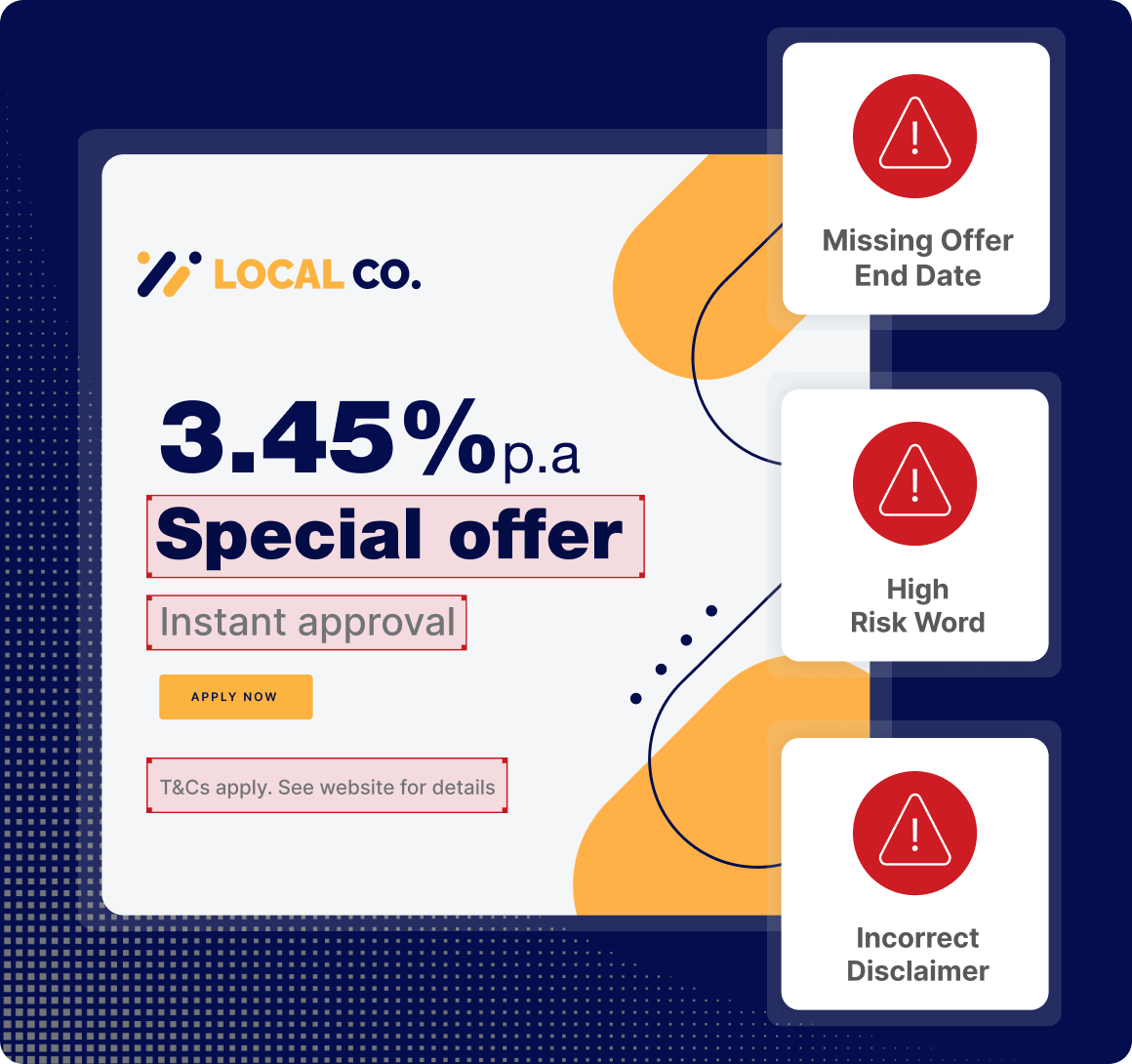
IntelligenceBank’s AI content risk detection integrates directly with Microsoft Word, PowerPoint, Figma and Canva through native plugins and a browser extension. As marketing teams draft campaign copy, product advertising, promotional materials, email content and social media posts, the platform’s AI risk detection engine checks the content against a library of custom rules, flagging ACCC risk areas in real time before the file is submitted for review.
For Australian businesses, these rules are configured to reflect the specific ACL obligations relevant to their industry and product set, as determined by a company’s senior management and legal and marketing compliance teams. Pre-built detection patterns cover the six highest-risk ACCC categories identified above: discount and pricing language, environmental and sustainability claims, availability and scarcity claims, performance representations, consumer guarantee exclusions and fine print adequacy. A copywriter drafting a promotional email who types ‘was $299, now $199’ receives an immediate flag that the claim requires substantiation documentation before it can be approved. A designer building a product page who includes a wave icon alongside recycled content language receives a flag that the environmental claim requires legal review, or if the legal team has approved this use case for a specific product, it can be noted as low risk only.
This upstream detection eliminates the most expensive type of ACCC marketing compliance failure: the campaign that has been fully produced, briefed, designed and scheduled before legal review identifies a non-compliant claim and requires the entire asset to be rebuilt. By moving the detection point to the moment of creation, IntelligenceBank makes ACCC marketing compliance a production efficiency rather than a production bottleneck.
Structured Approval Workflows That Create an Audit Trail
When content enters the IntelligenceBank workflow, it receives an automated ACCC marketing compliance risk score. Reviewers, including legal, marketing compliance and marketing leads, see the AI-flagged issues immediately, allowing them to focus review time on the actual risk areas rather than reading every word of every document. Parallel approval routing allows legal, marketing compliance and brand review to run simultaneously, compressing review cycles from days to hours while generating the complete, time-stamped audit trail that demonstrates the business applied a systematic ACCC marketing compliance process to every piece of marketing content. For some customers, sequential approvals occur.
The audit trail is not just an operational record. It is a material overview of the thought process of the approval in the event of an ACCC inquiry. A business that can demonstrate, for any piece of content the regulator examines, that it was reviewed against specific ACCC marketing compliance criteria by qualified reviewers and approved through a documented process is in a fundamentally different position than one that can only say that content was ‘reviewed by legal’ at some point.
Continuous Post-Publication Monitoring: The Capability That Closes the Last Gap
The most distinctive and operationally important capability IntelligenceBank offers Australian brands for ACCC marketing compliance is continuous post-publication monitoring. This is the function that addresses a significant source of ACCC liability: content that was compliant when it was approved but has since become non-compliant because of a business change that nobody tracked through to the marketing estate.
IntelligenceBank’s AI can be deployed to continuously scan live websites, Google Ads, social media channels and partner or distributor sites for set periods, such as weekly, monthly or quarterly, detecting content that contains ACCC-sensitive language categories including promotional pricing claims, environmental assertions, availability and scarcity language, performance claims and consumer guarantee exclusions. When the platform detects content in these categories, it generates a report the marketing and ACCC marketing compliance teams can review, assess and remove as required.
For Australian businesses with partner, dealer or franchise distribution networks, this monitoring capability is particularly significant. A bank’s mortgage broker network, a retailer’s franchise partners, an insurer’s financial adviser distribution channels and a manufacturer’s retail network all carry the same ACL liability as the brand’s own content, and can sometimes sit outside the formal marketing approval process that governs centrally produced content. IntelligenceBank’s monitoring scales to cover the full partner network without requiring a marketing compliance team large enough to manually audit every page.
| ACCC Risk Area | How Breaches Typically Occur | IntelligenceBank Capability That Prevents It |
|---|---|---|
| Misleading pricing and discount claims | A 'was/now' price claim is approved at the time of launch but the underlying pricing data changes or the promotional period extends beyond the original approval. Nobody updates the live content. | Continuous post-publication AI scanning detects promotional pricing language on live web pages, Google Ads and partner sites, flagging claims that may no longer be substantiated as product pricing or promotional periods change. |
| Greenwashing and sustainability claims | Environmental claims are drafted by the marketing team without legal review, or are accurate at a level of specificity but create a false impression through context, imagery or framing. | AI agents detect sustainability-related language, including 'carbon neutral', 'eco-friendly', 'ocean plastic', '100% renewable' and 'net zero', and flag for ACCC marketing compliance review. Potentially misleading imagery can also be automatically found. Custom rules can require substantiation evidence before approval. |
| Outdated offers on live channels | A promotional campaign expires or product terms change, but the offer language remains live on website landing pages, Google Ads or partner microsites because no systematic monitoring is in place. | Frequent monitoring of live websites, Google Ads, social media and partner/distributor sites flags offer language that may relate to expired promotions or changed product terms, triggering alerts before consumers see outdated claims. |
| Bait advertising and availability claims | Stock or capacity claims ('Only 3 left!', 'Limited time only', 'Offer ends Sunday') remain live on automated digital channels after the conditions they describe have passed. | Post-publication monitoring detects time-limited and scarcity-based language and overdue dates in live digital content and flags for human review when claims may no longer be valid. |
| Testimonials, reviews and endorsements | Marketing teams include customer quotes, star ratings or influencer endorsements that have not been verified or that were not independently given. | AI rules can be configured to flag testimonial language, star rating displays and endorsement formats in draft content, requiring ACCC marketing compliance review before the content is approved. |
| Fine print that contradicts headline claims | A headline claim ('Free delivery') is contradicted by fine print exceptions ('on orders over $100, exclusions apply') that are insufficiently prominent to cure the misleading headline. | Deterministic risk rules check for specified headline claims and verify that required qualification language is present, prominent and in proximity to the claim, flagging any content where fine print does not meet the required standard. |
| Consumer guarantee exclusions | 'No refunds' or 'change of mind' exclusions that breach statutory consumer guarantee rights appear in marketing materials, terms displayed in-store or website return policy pages. | Custom rules flag statutory exclusion language, including 'no refunds', 'no exchanges' and 'warranty void', for immediate ACCC marketing compliance review, preventing non-compliant exclusions from appearing in approved marketing materials. |
What Is the Operational Case for Investing in Marketing Compliance Infrastructure?
The economics of ACCC marketing compliance have changed fundamentally in the era of nine-figure penalties. A $100 million fine is not just a regulatory risk. It is a balance sheet event. A $50 million penalty for supermarket discount advertising represents a material percentage of annual profits. Even an $8.25 million greenwashing penalty, combined with the cost of a corrective notice campaign, legal fees, reputational damage and the operational cost of remediating the relevant products and content, represents a sum that dwarfs any plausible investment in ACCC marketing compliance infrastructure.
IntelligenceBank customers have reported ACCC marketing compliance review times have significantly reduced per document, and approval cycles compressed from multiple business days to a few. The ROI of that operational efficiency is significant. But it is secondary to the more important question of what it costs when the ACCC marketing compliance process fails and a breach occurs. One prevented enforcement action, one avoided corrective advertising campaign, one audit inquiry resolved with documented evidence rather than legal argument: each of these outcomes represents a return on investment that no spreadsheet analysis can fully capture.
For Australian marketing, legal and ACCC marketing compliance teams operating in an environment where the cost of a failure is measured in eight and nine figures, IntelligenceBank delivers AI risk detection inside the tools where content is created, structured workflows that generate audit-ready evidence of every review decision, and continuous post-publication monitoring that catches ACCC marketing compliance drift before it causes consumer harm or regulatory attention. To understand the operational ROI of automating marketing compliance reviews and live content monitoring, visit IntelligenceBank’s marketing compliance software ROI calculators at intelligencebank.com/resources/marketing-compliance-software-roi-calculator/.
ACCC Marketing Compliance FAQs
What is the ACCC and how does it regulate marketing in Australia?
The Australian Competition and Consumer Commission (ACCC) is the national competition and consumer watchdog, responsible for enforcing the Competition and Consumer Act 2010 (Cth) and the embedded Australian Consumer Law (ACL). For marketing teams, its most operationally relevant function is enforcing the ACL’s prohibitions on misleading or deceptive conduct (s18) and false representations (s29) in commercial communications. The ACCC can seek civil penalties in the Federal Court, issue infringement notices, accept court-enforceable undertakings and require corrective advertising. In the 2024 financial year, courts awarded more than $500 million in fines and penalties as a result of ACCC enforcement action.
Does the ACCC require proof of intent to establish a misleading advertising breach?
No. Intent is not a required element of a breach of section 18 of the ACL. If conduct in trade or commerce is misleading or likely to mislead a consumer, even if the business did not intend that outcome, a contravention may have occurred. This is one of the most important practical implications for marketing teams: a claim that was accurate when approved but has since become outdated, an environmental statement that is directionally true but creates a false specific impression, or a pricing promotion that was compliant on launch but is no longer substantiated by current pricing data can all constitute misleading conduct without any deliberate wrongdoing.
What are the most common types of ACCC marketing breach?
The most frequently enforced categories of marketing breach under the ACL are: misleading pricing and discount claims (including ‘was/now’ pricing where the ‘was’ price is not a genuine prior selling price); greenwashing and unsubstantiated environmental claims; drip pricing and hidden fees not disclosed in advertised prices; bait advertising and scarcity claims that do not reflect genuine availability; performance claims that do not reflect the typical consumer experience; consumer guarantee exclusions that purport to limit statutory rights consumers hold under the ACL; and misleading testimonials, endorsements and online review ratings.
What are the ACCC’s current enforcement priorities for marketing compliance?
The ACCC’s 2026 enforcement priorities relevant to marketing teams include: misleading pricing practices and promotional claims in the supermarket and retail sectors; environmental and sustainability claims (greenwashing), with a dedicated enforcement taskforce; misleading surcharging practices and undisclosed add-on costs; digital economy issues including misleading or deceptive conduct in influencer marketing, online reviews and in-app purchases; competition and consumer issues in aviation; essential services pricing and product claims in banking, telecommunications and energy; and consumer guarantee compliance in consumer electronics and e-commerce. The ACCC’s current list of key priorities can be found at https://www.accc.gov.au/about-us/accc-strategy-and-priorities/compliance-and-enforcement-priorities.
Does the ACL apply to digital marketing, including websites, social media and Google Ads?
Yes. The ACL applies to all commercial communications in trade or commerce, regardless of channel or format. Website landing pages, Google Ads, social media posts (including organic and paid content), email campaigns, influencer posts that are paid commercial arrangements and digital catalogues and product listings are all subject to the same ACL standards as print advertising, television commercials or in-store signage.
Can a business be liable for misleading content on partner or franchise websites?
This is a complex area of law, but the short answer is that the ACCC can take action against a business for misleading content published by a partner or franchisee where the brand has facilitated, endorsed or failed to adequately manage that content. A bank whose mortgage broker network publishes inaccurate rate claims, a retailer whose franchisees display non-compliant return policies, or a manufacturer whose distributors make unsupported performance claims each carries ACCC marketing compliance risk from partner content. This is why continuous monitoring of partner and distributor digital channels is a material ACCC risk management capability, not just a brand management one.
What is greenwashing and what does the ACCC say about it?
Greenwashing is the practice of making misleading or unsubstantiated claims about the environmental credentials of a product, service or business. The ACCC’s eight principles for environmental claims include: claims must be accurate, truthful and substantiated by evidence; important information must not be hidden or omitted; vague or absolute claims must be avoided unless fully substantiated; and imagery, colour and iconography that imply environmental credentials are subject to the same standard as explicit claims.
What is drip pricing and why is it an ACCC priority?
Drip pricing refers to the practice of advertising a headline price for a product or service, then progressively adding mandatory fees, charges, taxes or surcharges through the purchase or booking process, so the amount a consumer ultimately pays is materially higher than the price first advertised. The ACCC’s 2025-26 enforcement priorities explicitly include misleading surcharging practices and add-on costs. Common examples include advertised airfares that exclude mandatory taxes and booking fees, streaming subscription prices that exclude GST and insurance quotes that add stamp duty or policy fees at the final payment stage. Any business with a multi-step online booking or checkout process should review its pricing disclosure against the ACCC’s standard.
How does IntelligenceBank specifically help with ACCC compliance?
IntelligenceBank addresses ACCC marketing compliance risk at three stages of the content lifecycle. At creation, AI risk detection runs inside Word, PowerPoint, Figma and Canva, flagging ACCC-sensitive language categories including discount claims, environmental assertions, scarcity language, performance representations and consumer guarantee exclusions before content is submitted for review. In the approval workflow, automated risk scoring, parallel reviewer routing and a complete time-stamped audit trail ensure every piece of content is systematically reviewed and that evidence of that process is retained. After publication, continuous AI monitoring of live websites, Google Ads, social channels and partner sites detects content that may have become non-compliant since approval, generating alerts before consumers are affected. IntelligenceBank works closely with its clients to tailor the ACCC rules based on the advertiser’s direction and interpretation across its own products and services.
Does using IntelligenceBank guarantee my business will not breach the ACL?
No software can guarantee regulatory compliance. That determination always requires human legal and marketing compliance teams to apply judgement to the specific facts of each communication and each product. IntelligenceBank significantly reduces the risk of non-compliant content reaching consumers by automating systematic risk detection, providing content creators and approvers with alternatives that have been approved by the legal team, structured approval workflows and continuous post-publication monitoring. Australian businesses using IntelligenceBank should always maintain qualified legal oversight of their ACCC marketing compliance programme and ensure that the risk rules configured in the platform accurately reflect current product terms, regulatory obligations and ACCC enforcement priorities. The platform is compliance management infrastructure, not a substitute for legal advice.
This article provides general information about ACCC enforcement priorities and Australian Consumer Law obligations as they apply to marketing content, and does not constitute legal advice. The regulatory requirements applicable to your organisation will depend on your specific industry, products and activities. All penalties and case details referenced are drawn from publicly reported information current as at June 2026. You should seek independent legal advice before relying on this content.
More To Explore
Automating Auto Finance Marketing Compliance

How Golden Charter Manages Content Compliance