AI content risk review is the marketing compliance process of automatically checking marketing and disclosure content against approved source data before it goes live, and it is quickly becoming standard practice for asset managers publishing fund fact sheets. A fact sheet is the one- to two-page summary of a fund’s objective, performance, risk profile, holdings, and fees that gets updated every month or quarter and distributed to advisors, platforms, and investors. Because a fact sheet blends fast-moving numbers with fixed regulatory wording, small errors slip in easily and are hard to catch by eye, especially across dozens of funds and several languages at once.
Based on IntelligenceBank’s experience working with Asset Managers globally, if your team produces fact sheets at scale, you already know that proofreading against a spreadsheet does not scale with it. This guide walks through why fact sheets carry more compliance risk than most other marketing collateral, how IntelligenceBank’s marketing compliance software checks fact sheet content against a golden-source of truth, and what an implementation looks like from first upload to steady-state monitoring.
Here’s what you’ll learn:
- Why fund fact sheets are a distinct and higher-risk category of marketing content
- How small drift between a fact sheet and its source data creates regulatory exposure
- What an AI content risk review checks, and how it differs from manual proofreading
- How golden-source matching works against a risk-wording master spreadsheet
- Why exact-match and AI-assisted semantic matching are both needed
- How bulk upload and translated fact sheets are handled at volume
- What a first content risk review run typically surfaces
- How to evaluate a content risk review approach before you buy
- What a phased implementation looks like for a large fund range
- How ongoing monitoring reduces stale and inconsistent fact sheets over time
What Is a Fund Fact Sheet and Why Does It Carry Compliance Risk?
A fund fact sheet is a short, standardized document, usually one to two pages, that summarizes the key facts about a single mutual fund, exchange-traded fund (ETF), or other pooled investment vehicle. It exists to give investors a quick snapshot without requiring them to read the full prospectus, and it doubles as a marketing and distribution tool for sales teams and platforms.
Fact sheets carry compliance risk precisely because they sit at the intersection of marketing and disclosure. The figures and disclaimers featured on the fact sheet are potentially subject to regulatory scrutiny under frameworks like the Securities and Exchange Commission (SEC) marketing rule in the United States, the Australian Securities and Investments Commission (ASIC) requirements in Australia, or Key Investor Information Document KID requirements under PRIIPs in the EU, and the Key Investor Information Document in the UK, through 2026.
What a typical fact sheet contains
Most fact sheets follow a consistent template, which is exactly what makes automated checking possible.
- Fund overview: the fund’s name, investment objective, strategy, and asset class.
- Performance data: returns over one-, three-, five-year, and since-inception periods, usually benchmarked against an index.
- Risk metrics: volatility, Sharpe ratio, maximum drawdown, and beta.
- Portfolio composition: top holdings, sector or geographic breakdown, and asset allocation.
- Fees: expense ratio, management fees, and any load charges.
- Fund details: inception date, assets under management (AUM), manager name and tenure, and minimum investment.
- Risk disclosures: required regulatory language, often including a version of “past performance is not indicative of future results.”
How Do Errors Creep Into Asset Management Fact Sheets?
Most fact sheets are now generated programmatically from underlying data feeds covering holdings, performance, and risk, rather than typed up by hand. That reduces one class of error but introduces another: template drift, stale figures, and translation inconsistency across markets. If there is not a frequent and automated check, successive template versions can quietly fall out of sync with the source of truth, and nobody notices until a regulator, auditor, or advisor does. And that’s where the fines can occur.
Where drift typically shows up
A handful of failure modes account for most of the discrepancies asset managers find.
- Stale risk wording: a required risk disclosure exists in the source data but has dropped out of the published fact sheet, or vice versa.
- Wrong reporting period: a July fact sheet still shows June’s performance table because a template update did not roll forward.
- Template version drift: funds on an older template version carry historical quirks that funds on the current template do not.
- Translation inconsistency: a translated fact sheet does not carry the same required wording, or carries it with subtly different intent, as the source-language version.
- Minor numeric mismatch: a fee, return, or AUM figure differs slightly from the golden-source spreadsheet, often from a stale data pull.
What Is an AI Content Risk Review and How Does It Work?
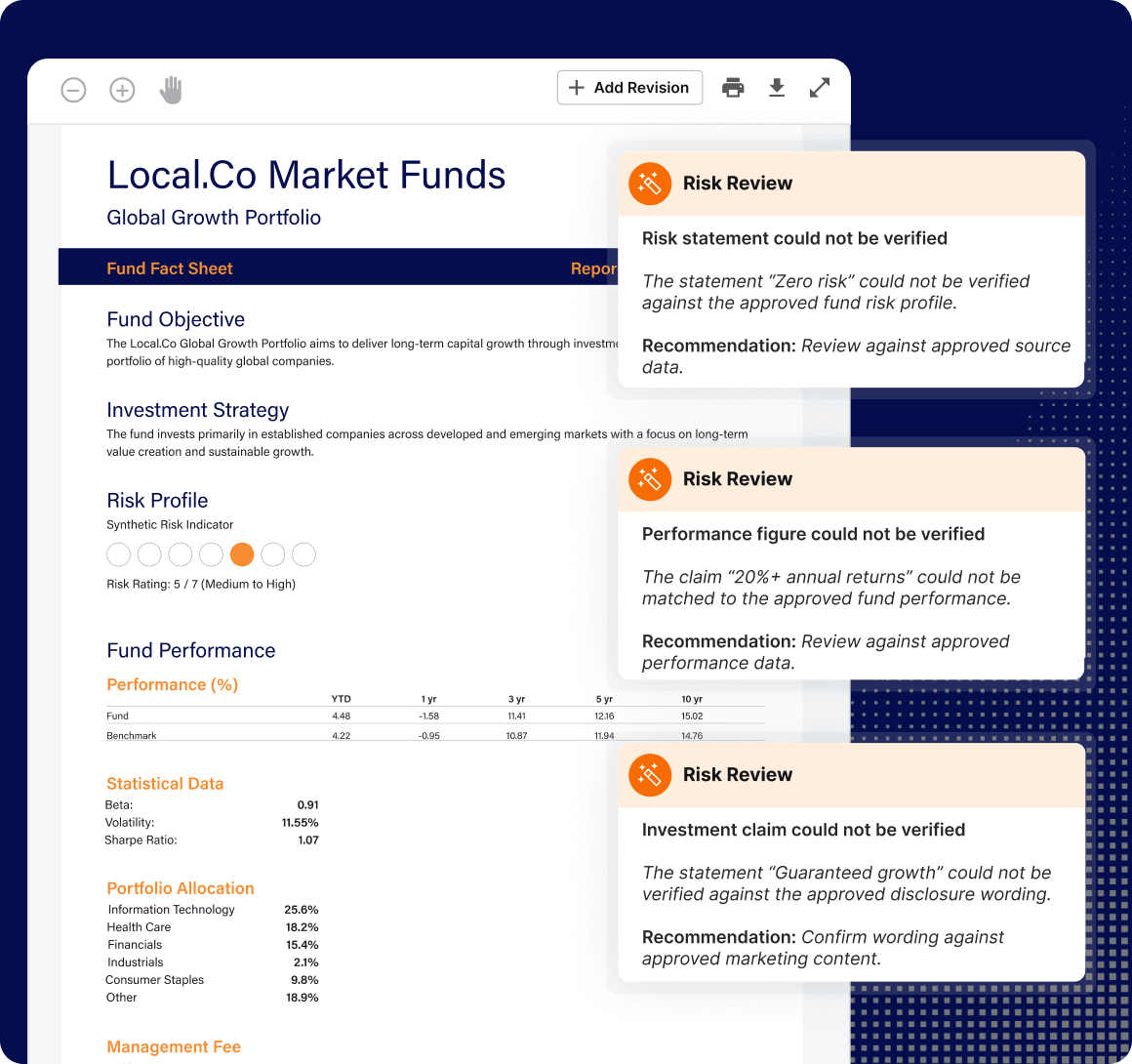
An AI content risk review uses a mix of deterministic and/or LLM AI rules and checks every fact sheet’s content against golden-source data for that fund and flags any discrepancy, including minor ones, so the compliance or marketing team can either accept and republish or correct it.
The review does not replace human judgment. Rather, it surfaces points of difference between what is published and what the source of truth says should be published, and a reviewer decides what to do with each flag.
Two matching approaches, used together
Fact sheets rarely match their source data word for word, so a content risk review needs more than a simple text comparison.
- Exact-match detection: the baseline check, comparing fact sheet text character-for-character against the golden-source spreadsheet to catch missing or altered wording. This includes translated fact sheets, where an approved translated version of the required wording is on file.
- AI-assisted semantic matching: used where wording is not text-identical, to confirm that the intent of a required disclosure is present even when the phrasing has drifted.
How Does Golden-Source Matching Work in Practice?
The golden-source reference is typically a spreadsheet the compliance team already maintains, which IntelligenceBank treats as the source of truth rather than requiring a separate system of record. As scope expands beyond risk wording, equivalent golden-source spreadsheets can cover other static sections, such as fund overview language or fee disclosures, since spreadsheets are an acceptable source format throughout.
A first run against a fund range that has drifted over several template versions is expected to surface a large number of flags, and that is a normal and expected outcome rather than a sign the tool is miscalibrated.
| Check type | What it catches | Matching method | Typical volume |
|---|---|---|---|
| Risk wording | Missing or altered required disclosures | Exact match + semantic match | Highest flag volume on first run |
| Performance tables | Wrong or stale reporting period | Presence and period check | Moderate |
| Fees and fund details | Numeric drift from source spreadsheet | Exact match | Low once stabilized |
| Translated fact sheets | Inconsistent wording across languages | Exact match against translated golden source; semantic match where no approved translation exists or wording has drifted | High at scale (thousands per month) |
Why Can’t Asset Managers Just Review Fact Sheets Manually at Scale?
As an example, a mid-sized asset manager might run sixty to seventy funds, which sounds manageable until new versions or even translations are factored in. Once every fact sheet is produced in multiple languages for different markets, the same sixty to seventy funds can generate thousands of fact sheet versions in a single month.
One-by-one manual upload and review is not viable at that volume, and neither is a spot-check sampling approach, since a single missed risk disclosure or stale performance table is still a compliance exposure regardless of how many other fact sheets were reviewed correctly. See how our content collateral tracker keeps count of every asset in circulation across markets.
Who typically owns this problem
The same operational strain shows up across the client base, regardless of asset class or region.
- Compliance teams: responsible for sign-off but without the bandwidth to proofread every fact sheet against a spreadsheet by hand every cycle.
- Marketing and content teams: under pressure to keep fact sheets current and consistent across every market the fund is sold in.
- Distribution and platform teams: who need confidence that what is on a third-party platform matches what compliance actually approved.
How Should Asset Managers Choose a Content Risk Review Approach?
Not every content review tool is built for regulated, data-heavy documents like fact sheets. The right approach needs to treat an existing spreadsheet as an acceptable source of truth, support bulk processing, and combine exact-match checking with semantic matching for wording that has drifted over time.
It is worth evaluating any option against how it will actually be used month over month, not just how it performs in a single demo upload.
Questions worth asking a vendor
- Source flexibility: can the tool use an existing spreadsheet as the golden source, or does it require rebuilding the reference data in a new system?
- Matching depth: does it offer AI-assisted semantic matching, or only exact text matching that fails the moment wording drifts?
- Bulk handling: can it process thousands of fact sheets a month, including translated versions, without one-by-one manual upload?
- Table awareness: does it check tables for period correctness, not just presence of a table?
- Integration path: is there a route to connect directly to the fact sheet provider so flagged results come back automatically over time?
How Do You Implement AI Content Risk Reviews Across a Global Fact Sheet Program?
A phased rollout works better than attempting every market on day one. Most asset managers start with the highest-risk section, such as required risk wording, before expanding the golden-source library to cover other static sections of the fact sheet.
A phased implementation path
- Start with one golden source: connect the existing risk-wording spreadsheet first, since it is usually already maintained and requires no new data entry.
- Run the first full-range review: expect a high number of flags on this pass, since historical template drift surfaces all at once.
- Triage and correct: compliance reviews the flags, corrects genuine discrepancies, and confirms which flags are false positives to refine matching.
- Expand source coverage: add golden-source spreadsheets for other static sections, such as fund overview text or fee disclosures, as scope grows.
- Move toward direct integration: connect to the fact sheet provider directly so flagged risks come back automatically instead of relying on manual bulk uploads.
Over time, the goal shifts from catching a backlog of historical drift to maintaining a steady state where every new fact sheet is checked against the source before or immediately after it publishes.
AI Content Risk Review FAQs
What is the difference between a fact sheet and a prospectus?
A fact sheet is a short, one- to two-page marketing summary of a fund’s objective, performance, and fees, while a prospectus is the longer, legally binding document covering full terms and conditions. Fact sheets accompany the prospectus as a summary layer intended for quick reference rather than complete legal disclosure.
How is an AI content risk review different from manual proofreading?
Manual proofreading relies on a person comparing a fact sheet against a spreadsheet line by line, which does not scale once translations push monthly output into the thousands. An AI content risk review automates that comparison, combining exact-match detection with semantic matching so wording that has drifted still gets flagged for a human reviewer.
Why does a first content risk review run flag so many discrepancies?
Fact sheets often drift from their golden source over successive template versions, so a first run against a fund range that has not been checked this way before typically surfaces a large volume of historical quirks. This is an expected outcome of the initial pass, not a sign that the matching logic is miscalibrated.
Can a content risk review use a spreadsheet as the source of truth?
Yes, a spreadsheet is an acceptable golden-source format, and many asset managers already maintain one for required risk wording. As scope expands to other static sections of the fact sheet, equivalent spreadsheets can serve as the source of truth for those sections too.
How does content risk review handle fact sheets in multiple languages?
Translated fact sheets are checked against the same golden source, extended to cover approved translated wording. Where a translation has already been approved, the review runs an exact match against it. Where no approved translation exists yet, or the wording has drifted, AI-assisted semantic matching confirms the intent of the disclosure is still present. This catches both missing translations and cases where a translated fact sheet no longer matches the wording compliance actually signed off on.
Does content risk review check every number in a performance table?
The emphasis is on presence and period correctness, such as confirming a July fact sheet actually contains July’s performance data, rather than validating every individual figure in every table. Tables are checked as part of the overall review, but the goal is catching structural and timing errors rather than re-deriving every calculation.
If you’re ready to catch fact sheet discrepancies before they reach an investor or a regulator, contact us for a demo.